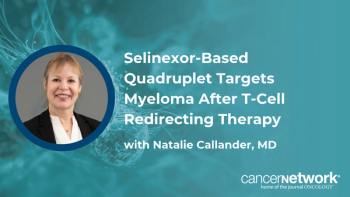
Natalie S. Callander, MD, discussed the rationale for combining selinexor, carfilzomib, subcutaneous isatuximab, and dexamethasone in relapsed/refractory myeloma.
Jan Kitajewski, PhD, discussed how pooled expertise, pilot funding, and investigator support help move bench discoveries toward multicenter trials.
In an interview with CancerNetwork® at the 2026 Big Ten Cancer Research Consortium (CRC) Summit, Jan Kitajewski, PhD, discussed how the consortium's framework supports the translation of laboratory discoveries into early-phase multicenter clinical trials. Kitajewski is director of the University of Illinois Cancer Center and head of the Department of Physiology and Biophysics at the University of Illinois Chicago (UIC).
The Big Ten CRC was created in 2013 to conduct collaborative, hypothesis-driven, highly translational oncology trials that draw on the scientific and clinical expertise of Big Ten universities. Kitajewski described several ways the consortium supports that work: pilot funding for bench-to-clinic projects; a newly launched program for early-stage investigators; and information sharing through summits, workshops, and regular meetings of center directors. He also pointed to joint efforts to secure industry, philanthropic, and other external funding.
Kitajewski's own research focuses on tumor angiogenesis, cell fate determination, G protein–coupled receptor signaling, and pathway remodeling. That work includes the development of Notch decoys and, more recently, Notch peptibodies.
Transcript:
Kitajewski: The knowledge at each of our institutions related to what is coming from the bench and moving to the clinic, or what we refer to as the translational transition, is immense. Each individual has expertise, but the collective expertise of all the cancer centers in the Big Ten is positioned to assimilate, support, and identify, in a much better fashion, which lead findings to take into a preclinical setting. Beyond that, if a preclinical discovery is made and there is movement toward the clinic, we can use the consortium to increase the patient base of who we might accept, whether that is a broad definition of who could be included or very tightly defined [eligibility criteria], through the Big Ten Cancer Research Consortium.
So, how does the Big Ten CRC facilitate this? One of the starting points is pilot funding: ensuring that there are pilot funds for basic or bench-to-clinic projects. Another is training and supporting early-stage investigators. The Big Ten CRC has a variety of working groups aimed at helping early-stage investigators take advantage of the collective wisdom of different sites, which all bring different perspectives and different levels of expertise. That is one of our newest programs; we are launching a new program to support early-stage investigators.
There is also the dissemination of information across different Big Ten sites. Some of that comes from conducting summits like this, having workshops and breakouts, and having regular meetings of the directors. Finally, there are initiatives we are starting to work on together to secure industry support, philanthropic support, or other external funding.
All these things mean we are much more effective. Our collective enemy is cancer, and we are one team fighting a big problem. We are continually supporting and advancing a variety of methods to pool our expertise and tackle the problem of cancer.