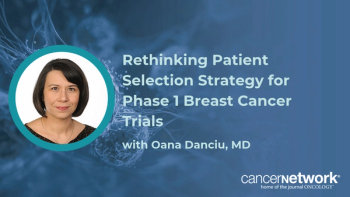
Oana Danciu, MD, explained why phase 1 breast cancer trials are moving earlier in the treatment course and how disease stability guides patient selection.
Differentiating between CRS and IEC-HS remains a challenge in mitigating toxicity associated with cellular therapy, said Tiba Al Sagheer, PharmD, BCOP, BCACP.
At the 2026 National ICE-T Conference in Orlando, sessions included a presentation titled “Thresholds and Therapeutics: A Precision Approach to CAR T Toxicity Management,” which addressed how pharmacists and clinicians should decide when to escalate treatment for CAR T-cell–related toxicities.
Presenter Tiba Al Sagheer, PharmD, BCOP, BCACP, pharmacy quality improvement coordinator for transplant and cellular therapy at Miami Cancer Institute of Baptist Health South Florida, spoke with CancerNetwork® about the context for her session, which was primarily based on emerging biomarkers that may help guide toxicity management strategies following cellular therapy. She ultimately noted that there is still no definitive answer or threshold for initiating prophylaxis. Additionally, she described how differentiating between immune effector cell (IEC)–associated hemophagocytic lymphohistiocytosis (HLH)–like syndrome (IEC-HS) and cytokine release syndrome (CRS) represents an ongoing challenge in the field.
Transcript:
CancerNetwork: What was the background or inspiration for your presentation focusing on thresholds and precision approaches to toxicity management related to CAR T-cell therapy?
The inspiration for that particular talk was the data that are emerging on what biomarkers to look for and how that determines what toxicities are going to emerge, and how we pull the trigger. There is a 2026 American Society for Transplantation and Cellular Therapy (ASTCT) consensus guidance document that goes over what those biomarkers are and what we should be looking at; it stratifies them into something that we must have or should have, can have, and is nice to have. It is nice to have that consensus guidance to guide us in terms of what we should really be doing as routine testing and what should be readily available vs things that should be tested just to keep for research purposes.
Ultimately, what do you hope those in attendance took away from your presentation?
We still do not have the answer. We do not know a true threshold, whether it is just the ALC or different markers, to tell us when you should pull the trigger for prophylaxis based on the different agents available for preventing delayed neurotoxicity because we do not have good treatments for those delayed neurotoxicities. Another thing is the differentiation between CRS and IEC-HS, which comes down to a ferritin cutoff: slightly above 7000—7420 if I recall correctly—is the cutoff where you want to actually switch and start treatment for IEC-HS and escalate therapy.
Sagheer TA. Thresholds and therapeutics: a precision approach to CAR T toxicity management. Presented at the 2026 National ICE-T Conference; July 18, 2026; Orlando, FL.