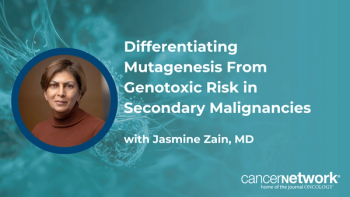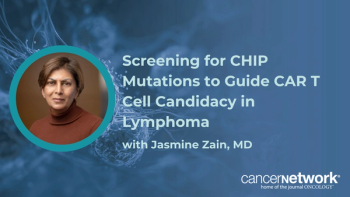
Jasmine Zain, MD, described how pre-existing CHIP mutations should inform pre-infusion risk counseling and treatment selection.
Education, REMS certification, and long-term management are key barriers to the widespread adoption of bispecific antibodies in the community setting.
In a visit to Columbia University Irving Cancer Research Center, CancerNetwork® spoke with Rajshekhar Chakraborty, MD, about addressing certain issues related to the adoption of bispecific antibodies among community oncology practices for the treatment of patients with multiple myeloma.
Chakraborty, an assistant professor of medicine in the Division of Hematology/Oncology at Columbia University Irving Medical Center, highlighted 3 key obstacles to the widespread use of bispecific antibodies in community settings. He noted that educating providers on the utility of bispecific antibodies in earlier treatment settings is critical, especially as novel regimens such as teclistamab-cqyv (Tecvayli) and daratumumab (Darzalex)
Transcript:
[Bispecific antibody access is] a great unmet need because so many of our patients are on bispecific antibodies and patients don’t like to drive to an academic medical center. They want these therapies close to home. [Usually], I see [the barriers] as 2 or 3 different buckets. One is education about bispecific antibodies in the community; that’s still an unmet need. They are now available in earlier lines of treatment. For example, the teclistamab and daratumumab combination will hopefully soon be FDA approved for patients with 1 prior line of therapy.* Similarly, single-agent teclistamab [may also be approved]. Now they will be in earlier lines of therapy. There needs to be increased education among community oncologists that bispecifics can be given earlier. That’s No. 1.
The second barrier I see is having the community oncologists universally REMS certified for all these bispecific antibodies, given there is still a fear factor for CRS and ICANS. That’s from the CAR [chimeric antigen receptor] T literature. But now we know that [for] patients who get bispecific antibodies in clinical trials, several large, randomized trials have been done and very few patients have developed clinically significant CRS. Most of the CRS is grade 1, grade 2 CRS is very low, and grade 3 and higher is pretty much nonexistent. That education needs to happen in the community: that CRS with bispecifics is very manageable. It’s rarely serious and almost never life-threatening.
Then the third thing I would say is the long-term management, with stringent infection prophylaxis, management of infections, and early assessment for signs or symptoms of infection. That’s where it’s usually less challenging to me, because when patients are in long-term follow-up, they’re also sometimes being followed at an academic medical center once every 3 months or once every 6 months. We can guide that part of the care and can guide the community physicians as to what infection prophylaxis patients need to be on. But the first 2 parts—starting the education about the efficacy and the safety and getting all the community oncologists REMS certified and removing the cloud from the fear factor regarding CRS and ICANS—are the main barriers.
*Editor’s note: The FDA had not yet approved teclistamab/daratumumab at the time Chakraborty spoke with CancerNetwork.
FDA grants third approval under the National Priority Voucher Program. News release. FDA. March 5, 2026. Accessed March 9, 2026. https://tinyurl.com/45hhbpau