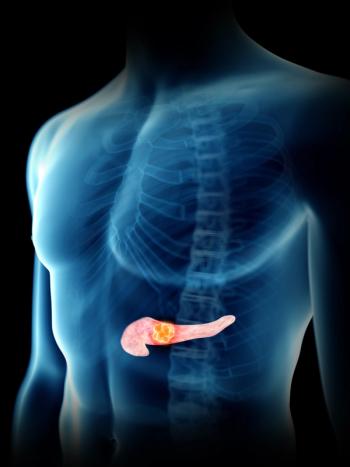
The oral KRAS G12D inhibitor VS-7375 produced responses in pancreatic, colorectal, and lung cancers in the phase 1/2 TARGET-D 101 trial.
Encorafenib, cetuximab, and FOLFIRI improved PFS vs in treatment-naive BRAF V600E-mutant metastatic colorectal cancer in the BREAKWATER trial.
Encorafenib (Braftovi) in combination with cetuximab (Erbitux) and chemotherapy—fluorouracil, leucovorin, and irinotecan (FOLFIRI)—significantly improved progression-free survival (PFS) in patients with previously untreated BRAF V600E-mutant metastatic colorectal cancer (CRC), according to results from the phase 3 BREAKWATER trial (NCT04607421) announced by Pfizer.1
This targeted regimen demonstrated a statistically significant and clinically meaningful PFS benefit compared with FOLFIRI chemotherapy with or without bevacizumab (Avastin) in the trial. BREAKWATER evaluated encorafenib with cetuximab, alone or in combination with chemotherapy, in patients with frontline metastatic CRC harboring BRAF V600E mutations.
These findings follow a
“These results build on the positive objective response rate [ORR] data we recently shared, providing further evidence of the meaningful benefit this [encorafenib]-based targeted approach may offer patients with BRAF V600E–mutant metastatic [CRC],” stated Jeff Legos, chief oncology officer of Pfizer.1 “The combination of significant responses and now improvement in PFS underscores the potential of [encorafenib] as a potentially practice-changing treatment option for patients and families [with] this challenging diagnosis.”
Results from Cohort 3 of the BREAKWATER study were also shared at the
Durability of response also favored the targeted approach, with 57.4% of responders in the encorafenib arm maintaining their response for at least 6 months compared with 34.5% of responders in the control arm. Subgroup analyses indicated that the clinical benefit was consistent across various prespecified factors, including age, with patients younger than 65 and those 65 or older both deriving benefit from the targeted triplet.
Although the overall survival (OS) data were immature at the time of the primary analysis, with a median follow-up of approximately 10.5 months, a descriptive analysis showed a trend favoring the encorafenib triplet (HR, 0.49; 95% CI, 0.237-1.032).
The BREAKWATER trial was an open-label, multicenter study designed to evaluate encorafenib and cetuximab with or without chemotherapy in the frontline setting. Cohort 3 randomly assigned 147 treatment-naive patients with BRAF V600E-mutant mCRC in a 1:1 ratio to either the experimental or control arm. Patients in the investigational arm received encorafenib at 300 mg orally once daily in combination with cetuximab at 500 mg/m2 intravenously every 2 weeks and FOLFIRI every 2 weeks. The control arm received investigator’s choice of FOLFIRI with or without bevacizumab.
Eligibility criteria required patients to be at least 16 years old or 18 years in select countries with previously untreated local- or central-lab confirmed metastatic CRC harboring the BRAF V600E mutation, an ECOG performance status of 0 or 1, and measurable disease per RECIST 1.1 guidelines.
The primary endpoint for Cohort 3 was ORR by BICR, with PFS being a key secondary end point. Other secondary end points were OS, DOR, time to response, and safety.
The safety profile of the encorafenib triplet was consistent with the known toxicities of the individual agents, and no new safety signals were identified. Serious treatment-emergent adverse events (TEAEs) occurred in 39.4% of patients receiving the triplet compared with 36.8% in the control arm. The most frequent any-grade treatment-related TEAEs in the experimental group included nausea (56%), diarrhea (41%), and vomiting (38%). Discontinuation rates for the chemotherapy backbone due to TEAEs were low and comparable between the investigational and control arms at 9.9% and 8.8%, respectively.