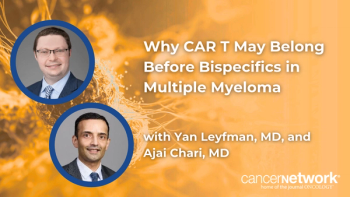
At the 2026 Chemotherapy Foundation Symposium, Ajai Chari, MD, explained how disease pace and BCMA sequencing guide choosing CAR T or bispecifics.
Ajai Chari, MD, discussed sequencing CAR T and bispecifics, fixed-duration therapy, emerging targets, and academic partnership in multiple myeloma.
As chimeric antigen receptor (CAR) T-cell therapies and bispecific antibodies move into earlier lines of treatment for multiple myeloma, clinicians face new questions about which patients should receive which modality, in what order, and for how long.
At the 44th Annual Chemotherapy Foundation Symposium (CFS®), Yan Leyfman, MD, a hematology-oncology fellow at the Meyer Cancer Center of NewYork-Presbyterian/Weill Cornell Medicine and a medical correspondent for CancerNetwork®, spoke with Ajai Chari, MD, professor of medicine at the University of California, San Francisco (UCSF), about how disease pace and B-cell maturation antigen (BCMA)–directed sequencing should inform the choice between CAR T-cell therapy and bispecifics.
Chari also discussed whether deep responses may allow some patients to stop therapy, which emerging targets and modalities may help overcome antigen escape, and why community oncologists should consider partnering with academic centers as myeloma care grows more complex.
Chari: First, it is worth mentioning that both products have shown not only progression-free survival [PFS] benefits but overall survival benefits. Many of us in the myeloma community feel that this movement is justified, because there is also a push in the community to save these for later, because that is where they were approved. But that assumes you do not have attrition—that the patients will be alive. And I think these products work better when used earlier. For example, bispecific monotherapy has a response rate of 60% to 70% in advanced myeloma; in newly diagnosed disease, monotherapy is 80%, and in smoldering myeloma, it is 95% to 100%. It is the same disease, but the T cells, we think, are better, and maybe the burden is lower.
Between the two [options], one of the main questions is the pace of disease. If it is rapidly progressive, particularly if it is extramedullary disease, by the time you control the myeloma, you may miss the opportunity to do the CAR T. I think rapidly progressing patients should probably go more toward an off-the-shelf product like a bispecific.
On the other hand, CAR T-cell therapies clearly have the best treatment-free interval that we have to date, with ciltacabtagene autoleucel [cilta-cel; Carvykti] in particular. The PFS is 3 years in patients with advanced disease, and we think it is better in less heavily treated patients. The cure fraction is about a third of patients in the heavily treated setting, and now maybe 50% [when used earlier]. If you want to give patients that treatment-free interval, I think CAR T should come first.
A lot of this debate goes back to the IMWG [International Myeloma Working Group] consensus paper. At that time, there were cilta-cel data showing that the PFS of 3 years drops to 5 months with a prior bispecific, or 9 months with a prior antibody-drug conjugate [ADC]. Admittedly, those are older data sets, from when these products were given until progression. My pushback is that an ADC at that time was given for 3 to 4 months, so it is not as though you were beating patients up with years of therapy, and we do not think the ADC affected soluble BCMA, BCMA expression, or T cells. So why would it decrease efficacy?
If you now look at the entire data set, every BCMA therapy has adversely affected the PFS of the next therapy. That is true for bispecifics before or after CAR T, and for CAR T before or after bispecifics. When you touch BCMA once, it will probably give you anywhere from a 40% to 80% decrement in the next PFS. If you are going to go through the hassle of apheresis, manufacturing, CAR T infusion, and half a million dollars, why not get the best mileage out of that, do the CAR T first, and then use your other products later?
We cannot, on the one hand, say that frontline PFS is expected to be 12 to 17 years and continue therapy for that long. And we cannot say we are going to define cure and not aspire to curing patients and stopping therapy. The nuance is how to do that in a thoughtful manner, and I think it has to be response and risk adapted.
In high-risk patients, the MASTER study [NCT03224507] already showed that you can be minimal residual disease [MRD] negative at 2 time points, but that does not guarantee long-term remission when you stop therapy.1 On the other hand, in standard-risk patients who are MRD negative, maybe we should be stopping.
I always make the analogy to lymphoma for the community: myeloma gets treated as myeloma, but lymphomas get treated as indolent follicular lymphoma, diffuse large B-cell lymphoma, or Burkitt lymphoma. You are not treating all of those patients the same. We need to move away from a cookie-cutter approach of quadruplet induction with or without transplant, and recognize that if you are MRD negative and standard risk, you may not need protracted therapy, as the [phase 3 ENDURANCE/E1A11 trial (NCT01863550)] showed.2 We need to hold ourselves accountable to doing fixed-duration therapy if we are going to move this field forward and cure patients, as we already have been doing.
One of the questions is whether you should combine existing targets, because that may deter antigen escape. We need to see longer-term data, but so far, for example, with ramantamig, the dual-targeting trispecific antibody, median PFS has not been reached at a median follow-up of almost 2 years, which is encouraging.
FcRH5 is another antigen that has been studied with cevostamab, and I think there are newer, low-affinity versions of that being studied. There is also mRNA-based therapy, where you inject a patient with a nanoparticle and the patient makes all 3 targeting T-cell engagers at once. That is one category.
Other antigens being explored for immunotherapy, which are earlier in development, include CD70, ROR2, SLAMF7, and SLAMF3. Then, moving away from that modality, there are small molecules: next-generation BCL2 inhibitors; bromodomain inhibitors such as inobrodib, which showed a 70% response rate in combination with pomalidomide and dexamethasone even in T-cell redirection–refractory patients; cemsidomide, which is a protein degrader; and MMSET inhibitors.3
Lastly, there are different modalities for delivering these therapies. In vivo approaches are the next wave. Do you really need to do T-cell apheresis and lymphodepleting chemotherapy, or can you inject patients with a modified viral particle? That is being explored for both CAR T-cell therapies and T-cell engagers.
From a philosophical standpoint, myeloma is becoming too complicated to manage when you are only seeing 3 to 5 patients a year. It is important to have an academic partner. I can speak on behalf of UCSF: we do not have the bandwidth to do everything at UCSF, but we are happy to partner and do video visits, for example, and then patients can get the best of both worlds. That is No. 1.
No. 2 is keeping up with the data, which now include, for example, quadruplet induction, doublet maintenance, and T-cell redirection in early relapse—none of which would have been discussed 5 years ago. If you want to keep up with the field, come to events like CFS to stay up to date.