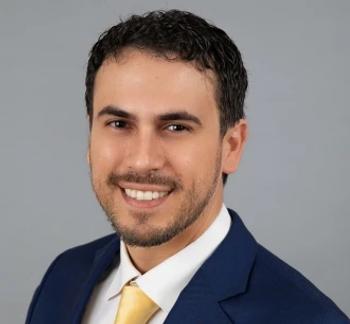
At the BIG10 CRC Summit, Mingjia Li, MD, outlined how pre-operative hemoglobin may signal treatment response in resectable NSCLC.
Lisa Carter-Bawa, PhD, APRN, discusses policy barriers, arts-based outreach, AI, and stigma in lung cancer screening.
CancerNetwork® spoke with Lisa Carter-Bawa, PhD, MPH, APRN, ANP-C, FAAN, FSBM, founding director of the Cancer Prevention Precision Control Institute at the Hackensack Meridian Center for Discovery & Innovation and professor at the Hackensack Meridian School of Medicine, about her research on lung cancer screening uptake, stigma, and nihilism. Carter-Bawa, a nurse practitioner of nearly 2 decades before pivoting to research, has focused much of her recent work on person-first communication strategies, community-based screening outreach, and the potential promise and pitfalls of artificial intelligence (AI) in shared decision-making around screening, including work developing the Lung Cancer Stigma Communications Assessment Tool used to audit the LungTalk screening decision aid.1
The conversation also touched on Pope Leo XIV’s recent lung cancer diagnosis. The Vatican announced in October 2026 that he had undergone a right lower lobectomy to remove a nodule that was confirmed to be lung adenocarcinoma.2 Carter-Bawa discussed what his public disclosure could mean for broader awareness of lung cancer screening and stigma. She said she hopes Pope Leo XIV’s transparency about his diagnosis and surgery helps normalize public conversation about lung cancer, as broader awareness that treatment exists, and that screening can catch disease early, is central to combating both stigma and nihilism.
Carter-Bawa: Having nearly 2 decades of experience as a nurse practitioner before pivoting to research makes me ask patient-focused questions because I’ve been in the clinic and have treated patients. I’m not asking questions just based on theory or theoretical underpinnings; I’m asking questions that I’ve seen my patients ask. It’s also helped me see the patient perspective firsthand and come up with research questions that seem to matter from the patient perspective.
I think the biggest policy change would be if we were able to cover the entire continuum of lung cancer screening, not just the initial scan. The initial scan is covered by most insurances because it’s a United States Preventive Services Task Force [USPSTF] recommendation, but many times people have a spot, nodule, or something that needs to be followed up with an additional scan, a biopsy, or additional testing, and that’s not necessarily covered because it’s downstream and diagnostic.3 I would love to see us cover the entire continuum because I think that can sometimes serve as a barrier when people learn there’s a potential cost incurrence.
We created a Paint and Sip cancer prevention program at Hackensack, where our community outreach and engagement team goes into the community and we do a Paint and Sip; a guided painting activity. We bring food and mocktails…We have our community health workers and patient navigators there. While people are guided through the painting activity, we use the natural pause for the first layer of paint to dry to do a targeted educational presentation around a screen-detectable cancer.
The reason that’s important is because we’re meeting people in the community where they are. We’re also meeting them in a fun environment where people want to talk. It’s not clinical, it’s not sterile, and it doesn’t make people feel fearful. That’s part of the trustworthiness you’re gaining with your community. When you do that, people talk, and they want to hear more and learn more. You’re able to talk to them about cancer screening and build a relationship where you can help them navigate to getting screened.
The way we measure it is we track everybody who comes to our Paint and Sips, and we track the navigation pathway. How many people are referred, and do they actually show up? Do they actually get scanned? For those whose scans come back abnormal, we stay with them along the way and get them to the care that they need.
I think the greatest risk of applying AI to lung cancer screening initiatives is the fact that AI is not a person, so if you don’t keep a human in the loop, you risk losing some people. I think AI is great for being able to find people who are eligible for lung cancer screening and help get them into the clinic, but the conversation still has to happen with a person. I know there’s literature out there about chatbots being developed and that chatbots maybe can be empathetic, but I still think you need a human in the loop because, at some point, the person has to talk to a person.
One of the things I do worry about with AI is that large language models are trained on large amounts of data, and people who are historically underrepresented in that data are minorities and underserved populations. If you train the AI on data that doesn’t have good representation of those populations, you’re not necessarily going to get the best benefit of it, and it could unintentionally widen disparities even though you think you’re doing a good thing. That’s the unintended consequence.
The most common mistake clinicians make when they’re talking with a person who has a smoking history is leading the entire conversation with that smoking history question, or saying, “Did you smoke?” It’s definitely a clinically relevant point, but it doesn’t have to open the conversation for why the patient has come in to see you. It can be laced or woven into the conversation as you’re going along. But by leading with the “Did you smoke?” question, or [having] smoking as the very first thing that comes out of your mouth, you’re telling the patient that’s the most important thing. Unintentionally, you might be telling the patient that they’re to blame for their lung cancer diagnosis, which I’m sure [they] don’t mean.
I think progress looks like we’re using person-first language. [For example], you don’t see the word “smoker” anymore. That’s something we still see in lots of abstracts because it’s much easier to say one word as opposed to saying “person who smoked.” But I think progress looks like being able to bring the patient front and center as a person and a human being into the conversation, and part of that is through person-first language and not reducing them to their behavior.
I definitely have a lot of empathy for the Pope being diagnosed with lung cancer; nobody wants that diagnosis. But I have to commend him and the Vatican for being so transparent about it. Very quickly, they shared that he had a nodule, that he was going to have surgery, and then, after the surgery was done, very quickly told us it was a lung adenocarcinoma.
I think the fact that he did that, regardless of any smoking history, helps normalize lung cancer as a disease in this world, regardless of whether anyone smokes. I think that will actually do some good because people will talk about it more and it will get more awareness. That’s actually the biggest thing with lung cancer screening: people don’t know lung cancer screening exists. To see the Pope have surgery, have it be lung cancer, and have a lobe resection, I think people just don’t know unless they’ve experienced it in their own family. You don’t know that there’s treatment, and you don’t know that there’s a path forward; you hear “the big C” and think it’s automatically a death sentence. That’s the nihilism piece. I think his diagnosis is going to do a lot of positive things for both stigma and nihilism in the world.