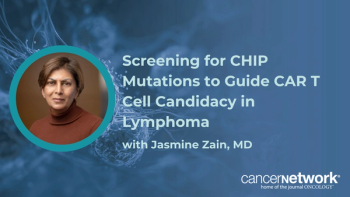
Jasmine Zain, MD, described how pre-existing CHIP mutations should inform pre-infusion risk counseling and treatment selection.
Reducing vein-to-vein time and expanding manufacturing capacity represent ongoing challenges to optimizing the use of cellular therapy across indications.
Following the 2026 National Immune Cell Effector Therapy (ICE-T) Congress in Charlotte, North Carolina, CancerNetwork® spoke with conference director Zahra Mahmoudjafari, PharmD, MBA, BCOP, FHOPA, about key themes that emerged from the meeting, particularly those related to the use of novel treatment modalities across different hematologic oncology populations. One session, she said, focused on advances in chimeric antigen receptor (CAR) T-cell and cellular therapies across multiple myeloma, leukemia, lymphoma, and other patient populations.
According to Mahmoudjafari, a clinical pharmacy manager in the Division of Hematologic Malignancies and Cellular Therapeutics at the University of Kansas Health System, the field is transitioning from innovating to optimizing the use of new cellular therapies. Current challenges include expanding the use of CAR T-cell therapies to earlier treatment settings as well as designing next-generation constructs such as dual-targeting agents to overcome antigen escape. She described how improving access to treatment by reducing vein-to-vein time, increasing manufacturing capacity, and building outpatient models may yield additional progress in the field.
Transcript:
One of the biggest takeaways from the ICE-T conference and the CAR T and cellular therapy session was how quickly we’re moving from innovation to optimization in diseases like multiple myeloma, lymphoma, and even some leukemias. The question is no longer, “Does CAR T work?” It’s, “How do we deliver it better and earlier into more patients?” We’re seeing strong momentum toward earlier-line use, particularly in multiple myeloma and in large B-cell lymphoma. Along with ongoing work to improve durability of response and reduce relapse, there is also a lot of discussion around perhaps next-generation constructs: things like dual-targeting CARs and strategies to overcome antigen escape. From an operational standpoint, the conversation has shifted toward access. This access is something we’ve talked about for a long time, but this is inclusive of not only reducing vein-to-vein time [but] expanding manufacturing capacity and then building outpatient models safely, where I think the pharmacists, health systems, and other interdisciplinary team members are playing a critical role translating these advances into something not only scalable but sustainable.