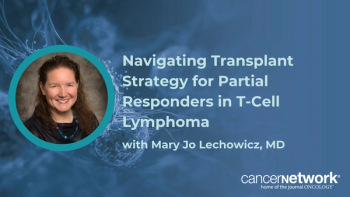
Mary Jo Lechowicz, MD, discussed how pre-transplant depth of response informs the choice between autologous and allogeneic HSCT in T-cell lymphoma.
Matthew Matasar, MD, highlighted key phase 3 studies seeking to elucidate the clinical benefit of chemotherapy-free regimens in follicular lymphoma.
Investigators are working to elucidate the role of bispecific antibodies in the follicular lymphoma landscape and if chemotherapy-free regimens could be feasible for these patients.
In an interview with CancerNetwork® following the
Moreover, he touched upon key trials ascertaining the validity of such approaches, including the phase 3 SWOG S2308 trial (NCT06337318) comparing rituximab (Rituxan) with mosunetuzumab (Lunsumio) among patients with low burden disease; the phase 3 EPCORE FL-2 trial (NCT06191744) evaluating epcoritamab (Epkinly) plus rituximab and lenalidomide (Revlimid; R2) vs chemoimmunotherapy and maintenance in untreated follicular lymphoma; and the phase 3 SOUNDTRACK F1 trial (NCT06549595) assessing surovatamig (AZD0486) with rituximab in untreated follicular lymphoma.1-3
Noting that the adoption of bispecific antibodies across the oncology spectrum has increased, including many solid tumor indications, Matasar suggested that a “rising-waters-lift-all-ships scenario” has emerged. He concluded that, based on the pace of community adoption of these agents, the lymphoma community will likely be positioned to meet the demands of bispecific use as the need to deploy them grows.
Matasar is chief in the division of Blood Disorders at Rutgers Cancer Institute/Jack & Sheryl Morris Cancer Center, and a professor of medicine at Rutgers Robert Wood Johnson Medical School.
[H]ow close we are to getting rid of chemotherapy? I would say that we are trying; we are obviously not there yet, but we are trying. There is a number of pivotal studies trying to look at moving bispecific antibodies into the first line that hold great promise. It makes sense on paper: giving these drugs to [treatment-naive] immune systems, to T cells that have not been [altered by] prior treatments, including bendamustine (Treanda), which is notably T-cell toxic, is inherently attractive. We have some limited exposure and experience already demonstrating safety and efficacy in this context, with good activity and low rates of toxicity. [It’s] all very encouraging.
We are pursuing this in a lot of different ways. We have mosunetuzumab monotherapy for low-tumor-burden [follicular lymphoma] in the phase 3 SWOG S2308 study; epcoritamab [Epkinly] plus R2 being evaluated vs chemoimmunotherapy and maintenance; and surovatamig, which we referenced earlier, being compared to chemotherapy as monotherapy in the SOUNDTRACK-F1 trial. There’s a lot of different parallel strategies as we are trying to figure out which are our best drugs, which are the right patients, and how deep this rabbit hole is.
In terms of how we move from putative success with these studies into wider deployment, I am encouraged by the pace of community adoption of bispecific antibodies not just in lymphoma—where we have seen a very nice uptake over the last year—but certainly being driven as well by the adoption of bispecifics in other disease states, including solid tumor malignancies. This is one of those rising-waters-lift-all-ships scenarios, in my opinion. As the clear need to deploy these agents in a broader range of patients grows, the lymphoma community is going to benefit from that work, and we’ll see our community partners become increasingly capable of delivering these treatments. My expectation is that by the time these studies read out positively in the years to come, we will have an oncology community that is ready to meet those data where they are and deploy them in the best service of our patients.