

News|Videos|August 9, 2026
Does Patient Selection Inflate CAR T Outcomes in Multiple Myeloma?
Author(s)Joshua Richter, MD, Marco Davila, MD, PhD
Joshua Richter, MD, and Marco Davila, MD, PhD, focused on real-world CAR T-cell therapy outcomes in multiple myeloma.
Advertisement
Episodes in this series

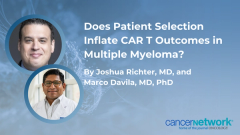
Marco Davila, MD, PhD, asked Joshua Richter, MD, whether CAR T-cell therapy outcomes are being engineered through patient selection, and what that means for the data supporting its use in earlier lines of therapy. The pair discussed how trial populations differ from real-world clinics, pointing to the phase 3 KarMMa-3 trial (NCT03651128) and the phase 3 CARTITUDE-4 trial (NCT04181827) alongside real-world outcomes data, and explained how identifying patients who are higher-risk is used to guide clinical trial design and risk mitigation rather than to exclude patients from cell therapy altogether.1,2
Davila is physician–scientist and service chief of the Lymphoma–Myeloma Adoptive Cell Therapy Service at Roswell Park Comprehensive Cancer Center. Richter is associate professor of medicine at the Tisch Cancer Institute, Icahn School of Medicine at Mount Sinai, and director of Myeloma at the Blavatnik Family Chelsea Medical Center at Mount Sinai.
Transcript:
Davila: Another question: patients who are younger, fitter, and who have great support systems are more likely to be candidates for CAR T-cell therapy. My question is, are CAR T outcomes being engineered through patient selection? What does this mean for the data being used to support its earlier use?
Richter: This brings up a couple of issues. One is that the average patient on a clinical trial is not the average patient who’s going to walk into your clinic or my clinic. Trial patients are typically younger, typically fitter, with fewer comorbidities. I saw someone in clinic this week who has 4 [types of] cancers. They’re never going to be on a clinical trial. There have been some great data sets looking at real-world outcomes of early and late relapse patients getting T-cell redirecting therapy, bispecific or CAR T, and in fact doing better than our other options. So to me, the collective data from the randomized early trials like the phase 3 KarMMa-3 trial and CARTITUDE-4 trial, looking at early relapse CAR T, along with some of the great real-world comparison studies, including a great paper by Surbhi Sidana, MD, of Stanford University, has really shown us that no matter how you slice it, CAR T is a really great option for many of our patients, even those who wouldn’t have fit the eligibility criteria for a trial.
Davila: Yeah, absolutely agree wholeheartedly. The real-world data is very reassuring that even patients who don’t fit that perfect clinical trial picture do well, and it shouldn’t be a concern that the numbers are being falsely inflated by patient selection. It’s also important to recognize that even for patients who have comorbidities or toxicities, we’re able to start identifying markers, whether that’s creatinine clearance or a particular tumor marker, that point to worse outcomes. I spend a lot of time trying to identify these patients, not to say they shouldn’t get cell therapy, but to ask how we can develop clinical trials, novel schemes to manage their toxicities, and novel combination therapies to improve their outcomes. Identifying these patients isn’t about saying they can’t get the therapy. The goal is identifying them, figuring out how we can mitigate their risk, and how we might develop clinical trials to improve their outcomes so that they match the picture of the ideal clinical trial patient.
References
1. Rodriguez-Otero P, Ailawadhi S, Arnulf B, et al. Ide-cel or standard regimens in relapsed and refractory multiple myeloma. N Engl J Med. 2023;388(11):1002-1014. doi:10.1056/NEJMoa2213614
2. Einsele H, San-Miguel J, Dhakal B, et al. Cilta-cel in lenalidomide-refractory multiple myeloma (CARTITUDE-4): an updated analysis including overall survival from an open-label, multicentre, randomised, phase 3 trial. Lancet Oncol. 2026;27(2):254-268. doi:10.1016/S1470-2045(25)00653-9
Advertisement
Related to this article

Jyoti Malhotra, MD, MPH on first-in-human clinical trials, lung cancer precision medicine in 2026, the disparities tension in drug development, and her move to Yale Cancer Center.
Chih-Yi “Andy” Liao, MD, discusses how oncologists are sequencing pemigatinib, futibatinib, and lirafugratinib and how their tolerability differs.
Chih-Yi “Andy” Liao, MD, discusses the FDA approval of lirafugratinib and what the field has learned about resistance to FGFR2 inhibitors.
Ayal Aizer, MD, MHS, discusses patients for whom single-fraction SRS may remain reasonable after brain metastasis resection.
C. Ola Landgren, MD, PhD, discusses the FDA’s endorsement of MRD as an accelerated approval end point in multiple myeloma.
Ethan B. Ludmir, MD, explains why advanced radiation techniques like protons fit nonoperative cholangiocarcinoma better than the preoperative setting.
Ayal Aizer, MD, MHS, says Alliance A071801 supports fractionated SRS as standard after resection, with comparable radiation necrosis rates.
Ethan B. Ludmir, MD, details which cholangiocarcinoma subsets, by tumor location, may benefit most from neoadjuvant radiation before surgery.
Advertisement
Advertisement
Trending on CancerNetwork
1
BCMA/GPRC5D CAR T-Cell Therapy Shows Early Efficacy in R/R Multiple Myeloma
2
Multimodal Biopsy Combo Shows Low Morbidity in Suspected Prostate Cancer
3
Integrating Talazoparib Plus Enzalutamide Into HRR-Mutated mHSPC Care
4
Aglatimagene Combo Shows Sustained Immune Remodeling in Prostate Cancer
5