

Commentary|Videos|August 12, 2026
Bolstering The Referral Process for CAR T-Cell Therapy in Multiple Myeloma
Author(s)Joshua Richter, MD, Marco Davila, MD, PhD
Fact checked by: Nicole Canfora Lupo
Academic clinicians have an incumbent role to improve access to novel cellular therapies, according to Marco Davila, MD, PhD.
Advertisement
Episodes in this series

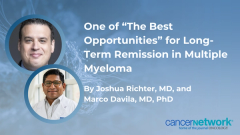
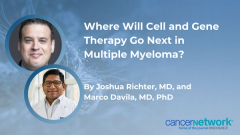
Joshua Richter, MD, and Marco Davila, MD, PhD, spoke about facilitating and strengthening referral relationships between community oncologists and cell therapy centers in the administration of chimeric antigen receptor (CAR) T-cell therapy to patients with multiple myeloma. They discussed how processes like holding treatment or giving bridging therapy require “equality” in decision-making between the referrer and cell therapy clinician. At the same time, Davila emphasized that academic clinicians bear an “incumbent” responsibility to improve access to novel treatments for patients and referrers alike.
Davila is a physician-scientist and service chief of the Lymphoma-Myeloma Adoptive Cell Therapy Service at Roswell Park Comprehensive Cancer Center. Richter is an associate professor of medicine at the Tisch Cancer Institute, Icahn School of Medicine at Mount Sinai, and director of Myeloma at the Blavatnik Family Chelsea Medical Center at Mount Sinai.
Transcript:
Richter: I'm excited because I get to ask the Andy Cohen “Watch What Happens Live”–style question: What breaks down in the referral relationship between community oncologists and the CAR T centers, and whose job is it to facilitate that relationship?
Davila: It's a relationship; that's the operative word. It's like, who has the final say in a marriage? In theory, it should be equal. Both the referrer as well as the cell therapy clinician have an equal say, an equal partnership. Overall, the primary referrer has more time with the patient. They're there through the entire story of the patient's treatment journey. I'm there for a short period of time, but during that period, I'm not making decisions by myself. I'm including the patient and the referrer in the thought process, my screening, my eligibility, my concern for risk, my treatment plan. Do we need holding therapy? Do we need bridging therapy? To me, this is a process that requires equality from the referrer as well as the cell therapy clinician.
That being said, I'm very invested in growing cell therapy for our service because it's such an amazing technology and we're not utilizing it enough. I want to be a champion for this in upstate New York, and that means I'm doing outreach to practices. I'm trying to develop policies and practices to [figure out], what are the barriers present to patients? What are the barriers present to referrers? How can I address those barriers? How can I mitigate them?
We've talked in other settings about how I’m now able to collect patients closer to home. If this is a patient who lives in Syracuse, I have a collection facility that I can send them to in Syracuse. If they're in Albany, we're trying to set one up near the Capital Region as well. In terms of my role as an academic clinician, I am not a private medical oncologist seeing 40 patients a day. Part of my time is spent not seeing patients to figure out how I can improve the utilization of cell therapy. There is a role incumbent on us as academic cell therapy clinicians to figure out, how can we improve the access to this technology? How can I make it easier for referrers and patients to be able to get this therapy?
Richter: Couldn't agree more. Although in a marriage, I would say my wife gets 100% of the decisions. I will defer to her. She is the academic referring doctor.
Davila: That's probably best. I think that's probably well worth it.
Richter: To your point, the key here, as you said, is that it's an ongoing relationship. It's not one call from the community to say, "Hey, Marco, give this patient a CAR T," and not one call from you saying, "Hey, they're back with you." I provide my cell phone [number], as I'm sure you do. We text back and forth. They say, "Hey, they've had a couple extra bowel movements. Do we need to…. Hey, are you thinking about Cyclospora, or are you thinking about IEC [immune effector cell–associated enterocolitis] colitis?” I think your points are extremely well taken there.
Advertisement
Related to this article
Jyoti Malhotra, MD, MPH on first-in-human clinical trials, lung cancer precision medicine in 2026, the disparities tension in drug development, and her move to Yale Cancer Center.
Chih-Yi “Andy” Liao, MD, discusses how oncologists are sequencing pemigatinib, futibatinib, and lirafugratinib and how their tolerability differs.
Chih-Yi “Andy” Liao, MD, discusses the FDA approval of lirafugratinib and what the field has learned about resistance to FGFR2 inhibitors.
Ayal Aizer, MD, MHS, discusses patients for whom single-fraction SRS may remain reasonable after brain metastasis resection.
C. Ola Landgren, MD, PhD, discusses the FDA’s endorsement of MRD as an accelerated approval end point in multiple myeloma.
Ethan B. Ludmir, MD, explains why advanced radiation techniques like protons fit nonoperative cholangiocarcinoma better than the preoperative setting.
Ayal Aizer, MD, MHS, says Alliance A071801 supports fractionated SRS as standard after resection, with comparable radiation necrosis rates.
Ethan B. Ludmir, MD, details which cholangiocarcinoma subsets, by tumor location, may benefit most from neoadjuvant radiation before surgery.
Advertisement
Advertisement
Trending on CancerNetwork
1
BCMA/GPRC5D CAR T-Cell Therapy Shows Early Efficacy in R/R Multiple Myeloma
2
Multimodal Biopsy Combo Shows Low Morbidity in Suspected Prostate Cancer
3
Integrating Talazoparib Plus Enzalutamide Into HRR-Mutated mHSPC Care
4
Aglatimagene Combo Shows Sustained Immune Remodeling in Prostate Cancer
5