

News|Videos|August 6, 2026
Why Earlier CAR T-Cell Therapy May Benefit Patients With Multiple Myeloma
Author(s)Joshua Richter, MD, Marco Davila, MD, PhD
Joshua Richter, MD, and Marco Davila, MD, PhD, weighed in on the optimal timing of CAR T-cell therapy for multiple myeloma.
Advertisement
Episodes in this series

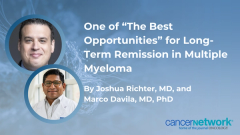
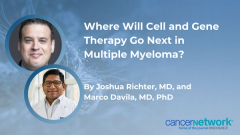
Joshua Richter, MD, spoke with Marco Davila, MD, PhD, about the current landscape of CAR T-cell therapy in multiple myeloma. With ciltacabtagene autoleucel (cilta-cel; Carvykti) and idecabtagene vicleucel (ide-cel; Abecma) both now FDA approved for use in earlier lines of therapy, the pair discussed where CAR T-cell therapy fits into the multiple myeloma treatment sequence, whether earlier use improves outcomes, and why early evaluation, regardless of a patient’s perceived eligibility for the therapy, may be critical to expanding access to cellular therapy.
Richter is associate professor of medicine at the Tisch Cancer Institute, Icahn School of Medicine at Mount Sinai, and director of Myeloma at the Blavatnik Family Chelsea Medical Center at Mount Sinai. Davila is physician–scientist and service chief of the Lymphoma–Myeloma Adoptive Cell Therapy Service at Roswell Park Comprehensive Cancer Center.
Transcript:
Richter: Hello and welcome to this CancerNetwork podcast about the current landscape of CAR T-cell therapy in multiple myeloma. I’m Dr. Joshua Richter, associate professor of medicine at the Tisch Cancer Institute, Icahn School of Medicine at Mount Sinai, and director of Myeloma at the Blavatnik Family Chelsea Medical Center at Mount Sinai.
Davila: And my name is Marco Davila. I am a physician–scientist as well as service chief for the Lymphoma–Myeloma Adoptive Cell Therapy Service at Roswell Park Comprehensive Cancer Center in Buffalo, New York.
Richter: Amazing. Today we’ll be discussing practical considerations relating to the use of CAR T-cell therapy in multiple myeloma care, touching on impacts on patient care, operational and referral workflows, and access to cellular therapy. Marco, let’s dive in. With cilta-cel and ide-cel both FDA approved in earlier lines of therapy, where does CAR T belong in the myeloma sequence? Is earlier better, or should clinicians give patients a one-shot therapy before moving on to safer options?
Davila: In general, I’ll say earlier is always better. I’ll qualify that a little. Earlier is better because you have time to coordinate, the T cells you collect are going to be better quality, the risks for toxicities are going to be lower, and the disease is more likely to be sensitive. Does that mean every patient absolutely requires it as a second line? No. It’s an individual decision made by the patient, informed by the practitioners on the myeloma and cell therapy team. However, what I’d argue is that early evaluation should happen for every patient with myeloma, even a patient whose referring physician says there’s no way this patient could get CAR T-cell therapy, I still want to see that patient. I want to be able to discuss it, because sometimes the barriers in front of a patient aren’t relevant anymore, and sometimes they’re simply logistical. The FDA is also changing how it manages the risk associated with these therapies, because it’s seeing that these risks are less of a concern than when the therapies were first approved. I’d say earlier evaluation is always better.
Richter: I’d completely agree. We used to worry in myeloma about saving something for a rainy day, and we know that rainy day doesn’t always come. Patients in the US only get around 3 to 4 lines of therapy despite all of these amazing advances, and I think Marco pointed out something critical: as we get into later lines, what’s the health of your T cells, and what’s our ability to control your disease while we wait out that manufacturing time? Also, medical things happen. What happens if a patient develops cardiac issues down the line? So I completely agree with your assessment. Is earlier better in general? Yes. But at a bare minimum, to your point, early assessment should happen for everyone, because we used to rely on that old framework of eligible for transplant or not. There are far fewer patients who are CAR T ineligible compared to auto transplant ineligible.
Advertisement
Related to this article

Herbert Lepor, MD, discussed NYU Langone's 1,000th focal cryotherapy procedure, Andre De Shields' case, and why prostate cancer treatment is at a turning point.

Sandra Turner, MBBS, PhD, shared ideas for radiation oncology teams to engage locally with World Radiotherapy Awareness Day.
Jasmine Zain, MD, described how pre-existing CHIP mutations should inform pre-infusion risk counseling and treatment selection.

Subcutaneous amivantamab is safer and more convenient for patients compared with the intravenous formulation, according to Misako Nagasaka, MD, PhD.
Mary Jo Lechowicz, MD, discussed how pre-transplant depth of response informs the choice between autologous and allogeneic HSCT in T-cell lymphoma.

Jasmine Zain, MD, described the molecular workup to determine whether a secondary malignancy after CAR T-cell therapy reflects direct insertional mutagenesis.

Misako Nagasaka, MD, PhD, explains how subcutaneous amivantamab’s shorter administration time benefits patients and infusion centers.
Misako Nagasaka, MD, PhD, discusses PALOMA-2’s 70% 3-year survival rate compared with historical MARIPOSA data for intravenous amivantamab.
Advertisement
Advertisement
Trending on CancerNetwork
1
Pembrolizumab/Enfortumab Vedotin Earns Positive CHMP Opinion in MIBC
2
Screening for CHIP Mutations to Guide CAR T Cell Candidacy in Lymphoma
3
FDA Approves Imlunestrant Combo in ESR1-Mutated Breast Cancer
4
FDA Approves sNDA for Taletrectinib in TKI-Naive Advanced ROS1+ NSCLC
5