

Opinion|Videos|November 2, 2026
Why the First-Line Choice Carries Weight in RCC
Terence W. Friedlander, MD, of UCSF Helen Diller Family Comprehensive Cancer Center explains why he does not save effective drugs for later in advanced renal cell carcinoma (RCC), responding to Elizabeth R. Plimack, MD, MS, of Fox Chase Cancer Center.
Advertisement
Terence W. Friedlander, MD, of UCSF Helen Diller Family Comprehensive Cancer Center explains why he does not save effective drugs for later in advanced renal cell carcinoma (RCC), responding to Elizabeth R. Plimack, MD, MS, of Fox Chase Cancer Center. He cites an International Metastatic Renal Cell Carcinoma Database Consortium (IMDC) analysis published this year in which only about 58% of patients reached second-line therapy, whether because of progression, comorbidities, or access to care. His goal is to make first-line therapy the only line a patient ever needs. When a patient has a large volume of disease or significant symptoms, he usually chooses a programmed cell death protein 1 (PD-1) inhibitor plus a tyrosine kinase inhibitor (TKI) for early control, noting that the TKI partners have not been compared head to head. He reserves dual immunotherapy for patients with a few lung metastases, slow-growing disease, or a strong reason to avoid a TKI, such as toxicity concerns.
Advertisement
Related to this article

Chinmay Jani, MD, highlights non-smoking risk factors, the impact of lung cancer on younger populations, and the value of comprehensive molecular testing.

Mark Burkard, MD, PhD, discussed genomic gaps, extreme survivors of metastatic breast cancer, and how minimal residual disease testing may refine care.

Rutika Mehta, MD, MPH, discusses perioperative durvalumab plus FLOT and first-line options for patients with low or negative PD-L1 gastroesophageal cancer.

Sunnie Kim, MD, discusses postoperative management for patients without a pathologic response after neoadjuvant durvalumab plus FLOT.
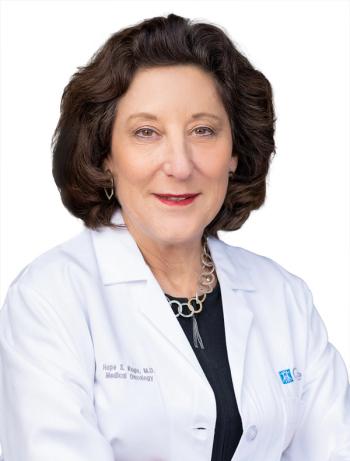
Hope S. Rugo, MD, discussed KEYNOTE-B49 data showing pembrolizumab plus chemotherapy improved PFS in PD-L1-positive HR+/HER2- breast cancer.

In a prospective cohort, a 3-gene blood model predicted 1-year castration resistance with an AUC of 0.89 in metastatic hormone-sensitive prostate cancer.

Rutika Mehta, MD, MPH, explains how she sequences MSI, HER2, claudin 18.2, and PD-L1 testing when tissue is limited in gastroesophageal cancer.

Dirk Schadendorf, MD, outlineed which patients with BRAF V600–mutant melanoma, including those with brain metastases, may be candidates for triplet therapy.
Advertisement
Advertisement
Trending on CancerNetwork
1
KEYNOTE-B49 Points to a PD-L1-Defined Subset Benefiting From Immunotherapy in Breast Cancer
2
Closing the Gaps in Precision Oncology for Breast Cancer
3
Navigating PD-L1–Low Gastroesophageal Cancer Treatment and Payer Challenges
4
Managing Patients With No Pathologic Response After Durvalumab Plus FLOT
5