
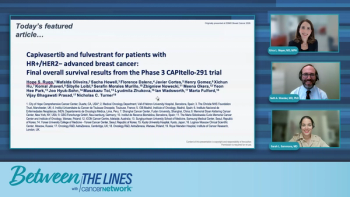
Experts unpack CAPITELLO‑291 survival data, guiding post‑CDK4/6 treatment choices with capivasertib, biomarkers, and evolving targeted options.
Experts unpack CAPITELLO‑291 survival data, guiding post‑CDK4/6 treatment choices with capivasertib, biomarkers, and evolving targeted options.
Erica L. Mayer, MD, MPH, of Dana-Farber Cancer Institute, reviews the rationale for capivasertib in hormone receptor positive, human epidermal growth factor receptor 2 (HER2)-negative advanced breast cancer, noting phosphatidylinositol 3-kinase (PI3K)/AKT pathway alterations in nearly half of patients, activation through PIK3CA or AKT alterations or PTEN loss, and guideline recommendations for capivasertib plus fulvestrant in altered disease after endocrine progression.
Erica L. Mayer, MD, MPH, of Dana-Farber Cancer Institute, reviews the design of CAPItello-291, a phase 3, double-blind, placebo-controlled trial in hormone receptor positive, human epidermal growth factor receptor 2 (HER2)-negative advanced breast cancer after endocrine progression, allowing up to 2 prior endocrine lines and 1 prior chemotherapy, requiring a majority of patients to have received a prior cyclin-dependent kinase (CDK) 4/6 inhibitor, permitting hemoglobin A1c up to 8%, and enrolling without biomarker selection.
Erica L. Mayer, MD, MPH, of Dana-Farber Cancer Institute, recaps the primary analysis of CAPItello-291 in hormone receptor positive, human epidermal growth factor receptor 2 (HER2)-negative advanced breast cancer, in which capivasertib plus fulvestrant improved progression-free survival from 3.1 to 7.3 months (hazard ratio, 0.50) in the PIK3CA/AKT1/PTEN-altered population and from 3.6 to 7.2 months (hazard ratio, 0.60) overall, with benefit regardless of ESR1 alteration or prior cyclin-dependent kinase (CDK) 4/6 inhibitor exposure, findings that supported the original approval.
Erica L. Mayer, MD, MPH, of Dana-Farber Cancer Institute, explains the statistical framework behind the final overall survival analysis of CAPItello-291, the phase 3 trial of capivasertib plus fulvestrant in hormone receptor positive, human epidermal growth factor receptor 2 (HER2)-negative advanced breast cancer.
Erica L. Mayer, MD, MPH, of Dana-Farber Cancer Institute, presents the key secondary endpoint of overall survival in the PIK3CA/AKT1/PTEN-altered population of CAPItello-291, the phase 3 trial of capivasertib plus fulvestrant in hormone receptor positive, human epidermal growth factor receptor 2 (HER2)-negative advanced breast cancer.
Erica L. Mayer, MD, MPH, of Dana-Farber Cancer Institute, reviews final overall survival in the overall population of CAPItello-291, the phase 3 trial of capivasertib plus fulvestrant in hormone receptor positive, human epidermal growth factor receptor 2 (HER2)-negative advanced breast cancer.
Sarah L. Sammons, MD, of the University of Maryland Greenebaum Comprehensive Cancer Center, and Seth A. Wander, MD, PhD, of Massachusetts General Hospital, join Erica L. Mayer, MD, MPH, of Dana-Farber Cancer Institute, to debate how post-progression therapy shapes survival interpretation in hormone receptor positive, human epidermal growth factor receptor 2 (HER2)-negative advanced breast cancer.
Erica L. Mayer, MD, MPH, of Dana-Farber Cancer Institute, presents exploratory overall survival data from CAPItello-291 in patients with prior cyclin-dependent kinase (CDK) 4/6 inhibitor exposure, showing about a 7-month difference favoring capivasertib plus fulvestrant in the PIK3CA/AKT1/PTEN-altered population of this hormone receptor positive, human epidermal growth factor receptor 2 (HER2)-negative advanced breast cancer trial, without statistical significance.
Erica L. Mayer, MD, MPH, of Dana-Farber Cancer Institute, reviews final safety data from CAPItello-291, the phase 3 trial of capivasertib plus fulvestrant in hormone receptor positive, human epidermal growth factor receptor 2 (HER2)-negative advanced breast cancer, reporting no new signals: diarrhea in nearly 80% of patients with about 10% grade 3 and no prophylactic antidiarrheal in the protocol, rash in about 40%, and all-grade hyperglycemia of 17% despite allowing hemoglobin A1c up to 8%.
Erica L. Mayer, MD, MPH, of Dana-Farber Cancer Institute, closes with the competitive landscape around capivasertib plus fulvestrant in hormone receptor positive, human epidermal growth factor receptor 2 (HER2)-negative advanced breast cancer.

Experts in breast cancer discussed final CAPItello-291 overall survival data and their implications for capivasertib plus fulvestrant.