Now Playing
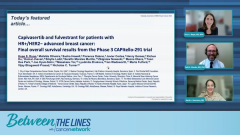
Experts unpack CAPITELLO‑291 survival data, guiding post‑CDK4/6 treatment choices with capivasertib, biomarkers, and evolving targeted options.
Erica L. Mayer, MD, MPH, of Dana-Farber Cancer Institute, opens a discussion of the treatment landscape for hormone receptor positive, human epidermal growth factor receptor 2 (HER2)-negative advanced breast cancer after progression on a cyclin-dependent kinase (CDK) 4/6 inhibitor. Sarah L. Sammons, MD, of the University of Maryland Greenebaum Comprehensive Cancer Center, describes a space changing multiple times a year, with novel oral endocrine agents approved for ESR1-mutated disease, including elacestrant, imlunestrant, and vepdegestrant, compendium support for imlunestrant plus abemaciclib, modest postMONARCH data for abemaciclib plus fulvestrant, and multiple phosphatidylinositol 3-kinase (PI3K) and AKT pathway options, with alpelisib for PIK3CA mutations and capivasertib extending to AKT1 and PTEN alterations. Seth A. Wander, MD, PhD, of Massachusetts General Hospital, explains how he layers disease extent, progression pattern, comorbidities, glycemic control, and symptom burden onto molecular findings, noting new approvals tied to ESR1 mutations and gedatolisib as the first PI3K/AKT/mTOR inhibitor approved regardless of PIK3CA status.