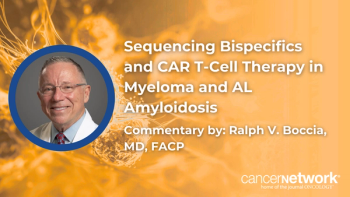
Ralph V. Boccia, MD, FACP, discusses CAR T and bispecific sequencing, fixed-duration therapy, MRD, and bispecifics in AL amyloidosis.
Ralph V. Boccia, MD, FACP, discusses step-up dosing workflows, REMS, staff training, caregivers, and hospital partnerships for bispecifics.
CancerNetwork® spoke with Ralph V. Boccia, MD, FACP, founder of The Center for Cancer and Blood Disorders, clinical associate professor at MedStar Georgetown University Hospital, and medical director of the International Oncology Network Clinical Research Program, about how community practices can safely deliver bispecific antibodies in the outpatient setting. Boccia, who has administered T-cell–engaging therapies exclusively as an outpatient in both clinical trials and commercial practice, discussed setting up a step-up dosing workflow, Risk Evaluation and Mitigation Strategy (REMS) certification, training for every member of the multidisciplinary team, and the role of caregivers. He also described how his practice handles emergencies during step-up dosing, including a dedicated on-call team of physicians and advanced practice providers (APPs), and how educating local hospital staff and ensuring access to tocilizumab (Actemra) can support management of cytokine release syndrome (CRS) and immune effector cell–associated neurotoxicity syndrome (ICANS).
Boccia: This is a real challenge for people who don’t have the experience of having done some of these things themselves. I have the experience and the benefit of having done 4 bispecific trials and 4 CAR T trials, as an outpatient [clinic]. All of my T-cell–engaging therapies have only ever been given exclusively in the outpatient setting. That’s my clinical trials, and since the drugs have been approved, the commercial use of those as standard of care.
What we initially had was the guidelines, or the roadmap, from the clinical trials. The clinical trials give you very defined lanes in which to practice and manage those patients. Many of the clinical trials that were originally hospital-observed or hospital-treated have since moved to the outpatient setting. Many of them initially enrolled hospitalized patients, and when we realized it was not necessary to admit them, we started doing clinical trials as an outpatient. Now we’ve done both: we have the original approval data and the follow-up studies that were done all as an outpatient. The data are out there that this can be done as an outpatient.
The problem is with colleagues who have never touched some of these agents in clinical trials. All they hear about are the adverse events, and without any experience, it’s hard to generate real confidence. If you work with peers who have done it, or if you’ve sent patients to a hospital or an academic center and watched how those patients got their step-up dosing, realized how little toxicity they had, and seen how the field is moving to all outpatient care, then it’s easy to get over that hurdle. Then you have to understand, from an organizational standpoint, how to develop a workflow that builds a team of people all the way from the front desk through the infusion area, including the health care providers in between, and then monitors patients afterward. Then it is something that can be done as an outpatient. That workflow and that organization are critical to set up before you start giving bispecifics.
Boccia: Getting certified for the REMS programs is a real piece of cake. Basically, all the health care providers who want to prescribe these agents do that, so our physicians need to do it. The APPs don’t always have to, because the patient is already on treatment; they’re not choosing a patient, they’re monitoring a patient. Many of them still get REMS certification. The REMS certification process takes about 10 minutes, and you do it one time per drug, so it’s not that big a deal. There’s a learning experience in doing it, so that’s additional education.
Boccia: Virtually everyone needs at least an understanding of what treating a patient with a bispecific involves. If you think about it, even the front desk staff, who don’t have any real medical education, need it. If a patient calls in and needs an appointment, they need to understand how that patient may be very different from another patient. If the patient calls in with a problem, the front desk needs to know: Do I send this to a triage nurse? Do I have the patient come in right away to see the health care provider? Even at that level, it’s necessary to know.
Then think about all the people who touch the patient, such as medical assistants. They have to make sure they accurately take a brief history and get a good blood pressure, pulse, and oxygen saturation, so they need some understanding of what they’re doing and why. Then our health care providers, whether that’s an APP or a physician, are the ones who have to understand what’s an appropriate patient and what’s an appropriate management strategy. How do I make sure the patient is safe? Do they have the proper caregiver, someone who’s going to do the reporting during the step-up phase, when the patient may not be able to accurately convey issues and problems? Of course, there are the infusion nurses who administer the drugs, the triage nurses who might be taking calls from patients who have adverse effects and toxicities, and our pharmacists, who are critical because they are also part of the teaching process, like our APPs, to get patients ready to start, to help them understand what to expect, and to monitor them during this phase.
Boccia: They require a caregiver, and it is for a shorter period. It’s during the step-up process that a patient getting bispecifics is at the biggest risk and depending on whether it’s a patient with multiple myeloma or a patient with lymphoma, we know when during step-up that risk might occur. A patient with multiple myeloma typically gets [CRS] with the first doses, and it might take 3 or 4 doses to get all the way up, whereas a patient with lymphoma typically gets it with the first full dose. Understanding those things is part of the educational process, and we want to make sure the caregiver understands that’s the critical time.
It’s the 48 hours around each of the step-up doses when they’ve got to be paying attention to the patient’s mental status, monitoring their blood pressure, pulse, and oxygen saturation, and recording those things. Then, when we see the patients the next day, or see them twice a day for a couple of days during each of the step-up dosing weeks, they can report and show us what the data look like. We don’t expect them to interpret it; we expect them to report it.
Boccia: The majority of clinics have some capacity. This is a new therapy that has taken over the hematologic malignancies, at least, and is now moving into solid tumors as well, as best available care and cutting-edge care. Clinics have to learn, and they have to make room for it. You may have to hire up to do some of these things. We’re all struggling a bit, of course, with hiring health care providers at all levels, but these therapies are here to stay, and we just have to figure out how to do it.
Boccia: The first thing we have to do is make sure we know which hospitals we expect the patients to go to. We don’t just randomly say, “If you have a fever, go to the hospital.” We make sure we have educated certain hospital staffs, so they know what to expect when the patient gets there. The patient then needs to be positioned geographically within 30 to 60 minutes of that hospital and has to understand that’s the hospital they go to.
Most of the time, we have a warning that the patient is going to get sick. The beauty of knowing and understanding this is that if the patient is going to get CRS, it always begins with a fever. The patient either has CRS or has an infection, and they’ve got to be seen. The patient and the caregiver understand that, and the connectivity must occur right at that time. If a patient has a temperature at 7 o’clock at night, you don’t wait until 9 o’clock the next morning. You report it right away.
So there has to be a monitoring system set up with the practice, whether it’s the physicians or the APPs, who are available 24/7. In our clinic, we have a specific team of 4 health care providers, 2 doctors and 2 APPs, who are available pretty much all the time. We rotate the responsibility, but the patients and caregivers have 4 cell phone numbers, and they know the first call they make is not to the answering service. It’s directly to the cell phone of a T-cell team member, who will then advise and guide them.
Boccia: Historically, hospitals in this country, because of diagnosis-related groups, do not like to admit patients for observation, and depending on the cost of these very expensive drugs, they don’t want to incur the cost of the drugs themselves. Some of my colleagues are fortunate enough to practice in areas where the hospitals want to partner and be a part of this, but that’s unique. In my role as chief medical officer for ION, the International Oncology Network, I have exposure to hematologists and oncologists across the country, and we have enough meetings that we share our experiences. Probably more than 90% of hematologists and oncologists don’t have a hospital that is willing to admit their patients for observation.
What we have always done is practice in a way where we give any form of therapy as an outpatient if we feel we can do so safely. As medical oncologists and hematologists, we have known for years that the drugs we give can cause toxicities and adverse effects, and we have to be prepared to deal with them. The way we deal with them is either we bring patients into the clinic and manage them there, if that’s safe and the right thing to do, or we send them to the hospital and become a part of the hospital care team. Then you have to educate the different hospital staffs: the emergency department, the hospitalist internal medicine services, the intensive care unit, and the pharmacists. As long as you get them on board and you have tocilizumab to reverse the effects of CRS, that’s the way we do it.
That’s the same way we’ve been doing things all along. A patient on cytotoxic chemotherapy can get a neutropenic fever. They go to the hospital, and we share in the care there. This is no different. Yes, we have tocilizumab, whereas for sepsis we’re not usually using tocilizumab, but you have the tools to treat the toxicities of the therapies you’re using at the time. We’re now flooded with immuno-oncology drugs and immune-related adverse events, and we learned how to deal with those over the last 10 years. Now we’re learning how to deal with CRS, ICANS, non-ICANS neurologic effects, and some of the autoimmune effects. Those are things we’re building into the repertoire and teaching our colleagues, and they’re learning themselves. If we have to admit a patient, the hospital teams get to share in that care, and they learn as well.