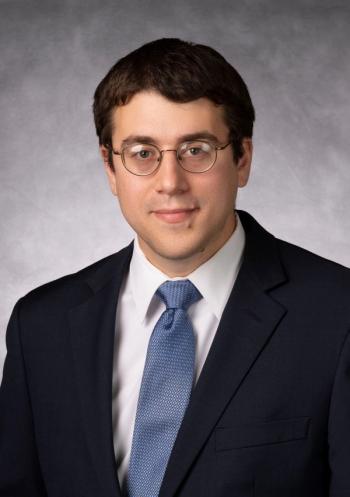
Zachary L. Bercu, MD, RPVI, FSIR, explains how the Liberty endovascular robotic system works from the operator’s perspective and what went into becoming its first adopting site.
Zachary L. Bercu, MD, RPVI, FSIR, discusses the Liberty robotic system’s applications in liver and kidney cancer as well as the feasibility of remote procedures.
In part 2 of this interview with Zachary L. Bercu, MD, RPVI, FSIR, he discussed various applications of the Liberty Endovascular Robotic System across oncology disease states. The system has use in liver cancer treatments, such as transarterial chemoembolization (TACE) and Y90 radioembolization, as well as in kidney cancer and other vascular conditions. It also has positive implications for reducing operator radiation exposure and physical strain while potentially offering remote procedures that could extend care to medically underserved areas.
In part 1 of this interview with CancerNetwork®, Bercu explained how the Liberty Endovascular Robotic System, developed by Microbot Medical and approved by the FDA in September, works from the operator’s perspective, and discussed what went into Emory becoming the technology’s first adopting site.1
Bercu is a professor in the Department of Radiology and Imaging Sciences and program director of Interventional Radiology Integrated and Independent Residency Programs at Emory University School of Medicine. He is also an adjunct professor in the Department of Biomedical Engineering at Georgia Tech.
Bercu: We envision this as a centerpiece of TACE or Y90 radioembolization. What we don’t know yet is whether this is platform technology that we should be using on every single case because it makes the procedure faster, easier, or maybe democratizes it? One thing I haven’t spoken about is, perhaps this technology takes somebody with 1 year of experience and gives them the capability to match the person who has 10 years of experience. Does that make cases faster, so you can get more patients in a day of work with the same team, without a cognitive and physical labor load on that team? That would be significant if we had a team working later into the night; instead, we could get more of our patients treated in a shorter time period. [Maybe the procedure] is helping facilitate our ability to get to the destination?
[Emory] is a big site for Y90 radioembolization, and personalized dosimetry is incredibly compelling. The closer that we get to the tumor, the more we think very intentionally about an absorbed dose in a specific area to cover the tumor and to reduce the toxicity to the normal liver that’s surrounding. We know that patients fare better, so getting through tortuous anatomy to a destination is something that fine motor control and endovascular robotics potentially allow us to do.
The chances are, as we study this more and more, it’s going to be some combination of all the above. [It is about] our ability to get more distally, where we alter the risk-benefit ratio, but also democratization and perhaps improved workflow efficiencies that allow us to take care of more patients at a certain time point. I suspect we’re going to find better operator ergonomics and comfort. If the operator is able to do this for many more years because they don’t have physical disabilities as a result of trying to be in a position that’s maybe not as natural, that’s going to keep somebody who’s a high-skilled interventional oncology operator being able to do their high-skilled work for longer.
All these things are potential benefits. We do need to study them and understand them. We have delivered Y90 through the device with no problem; we have delivered all sorts of embolics, from liquids to physical embolics like coils and plugs, without issue through the device. The way the gears grip the microcatheter is not an issue.
In kidney cancer, there are a few potential avenues. I just came back from [the 2026 Cardiovascular and Interventional Radiological Society of Europe (CIRSE) Annual Congress], for instance, and there was a great amount of work there. A.J. Gunn, MD, has done a wonderful amount of scholarly work looking at T1b renal cell carcinoma, where embolization prior to ablation is the methodology. But any sort of tumor that we look at or any sort of lesion, whether it’s renal cell carcinoma or some other lesion in the kidney, getting to the destination is important, and sparing as much of the normal kidney is critical. It opens the door to that risk-benefit ratio by helping us get more distally faster and easier.
Our robotics platform evolvement is happening at the same time as something in the angiogram suite: our capabilities in terms of visualization. We are strong believers in advanced imaging tools for interventional oncology; we do a lot of cone beam CT, we do embolization guidance, and we are getting better at mapping how to get to a destination. We’ve done this in all sorts of places in the body. We are getting to the point of having a super advanced Google Maps, Waze, or Apple Maps that shows us the routes to the destination. The robotics component is all the adaptive and augmentative features of our vehicles that can now take that data set and get us to that destination safely. It is not autonomous yet—that’s a thing that drives some tachycardia in all sorts of different people. I do think, at some point, that’s something in the future that’s going to happen. But that’s going to take a long time. Most robotics, just like most artificial intelligence right now, is augmentation technology. [Peter Fitzgerald, MD, PhD,] calls AI “augmented intelligence,” and there’s a whole field of augmentation robotics, which is short of the self-driving vehicles that we have in Atlanta. Most of the stuff that’s in your own personal vehicle that’s self-driving is still augmentation robotics—it still requires you to be present. That’s what we’re seeing with these augmentation robotic technologies.
This is still under investigation. The scientist in me wants to say that we need to explore this more before we jump into conclusions, but I suspect that if we get faster, [they will improve]. As interventional radiologists who do oncology, we’ve all experienced a case where we tried again to get around that last little corner, to get deeper into hepatic artery branches, and to get closer to the tumor, especially if somebody’s had multiple treatments before. We wanted to get that extra step. Having fine motor control may be the right technology, using endovascular robotics, to get us around that bend and get us there to improve our risk-benefit ratio and to reduce the amount of normal organ, whether it’s liver or elsewhere. Does it begin to move the needle on other parts of the body? There’s a lot of research looking at the pancreas. Can we alter the risk-benefit ratio by having these precision technologies that get us closer and closer to the destination?
We talked about the kidneys. I do a lot on the not-malignancy side, but on the benign prostate side; we do a lot of prostate artery embolization. As there’s an involvement and conversation around endovascular therapies for prostate cancer, being able to navigate to the destination is going to be critical. It doesn’t change the embolic that we deliver—those technologies are also in the pipeline, and they will alter the risk-benefit ratio—but getting to the destination, closer to the tumor, and away from normal tissue is going to yield higher benefit to patients at a lower risk. It’s going to reduce the amount of non-target delivery of our therapies to patients. Potentially, if we can do it faster and more effectively, it’s going to reduce radiation for patients. It’s going to reduce the level of sedation they’re going to need, and it’s going to allow us to turn over the room faster, so that we can reach more patients in any given day of work. All those things are the outcomes that we would like to study to understand how this is going to impact patients directly. Those are theoretical areas of focus that this technology may fundamentally change for patients.
The most major source of disability for interventional radiologists right now, even though we’re worried about radiation, is disability as a result of ergonomics in the angio suite—the lead that we wear, and the impact that it has on our spines, in particular. A technology like this is important because it brings us further away from the beam. Are we going to get to a point, as other technologies of old, where we may not need to wear lead? There are some innovative things we’re looking at in this domain. Could we sit outside in the control room after we get access? That’s another critical component. Even something as simple as standing more upright and focusing on the monitor may fundamentally change the axial load on our spine.
At Emory, we’re currently an institution that has all these unique experts. We have close to 30 interventional radiologists covering 7, to now almost 8, hospitals, depending on how you loop in the map across metropolitan Atlanta and beyond. Every expert can’t be everywhere. Does robotics allow us to reach patients at other sites? I know I alluded to this earlier, but could that also facilitate some of the transportation burden on our IRs having to go to multiple sites to deliver their care? What sort of physical disability comes from sitting in traffic, traveling, long commutes, and those sorts of things? If we’re able to better reach patients from 1 site, does that reduce not just the physical strain on the operator, but the cognitive and mental strain? We’ve all been there. The longer the commute that you have, the more it weighs on all the things you need to get done in a day to, at the end of the day, take great care of your patients. Those are all things that could potentially benefit from technology like this.
We think it’s very feasible. We’re getting very close to being able to launch our study. This is not something novel—it’s novel with this device, but the first cardiac catheterization that was performed robotically and remotely was actually in the 1990s. I was alerted that this was from a consulate for the country of France…This is not new. It’s been done in many different places, replicated across the world, but with fixed, huge equipment. This is the first time this would be done with a portable, disposable robot and very nimble mobility.
Our initial stage of this is looking from 1 Emory hospital to another. As interventional radiologists, we all have a shared skill set, but we also have a normal distribution of areas where we have unique expertise, and the expert in a certain area can’t be everywhere. How does that fundamentally change the paradigm on our own campus of how we deliver care at all these different sites? We’re envisioning whether there’s a future in which our first patient could be in rural South Dakota, our second patient in rural Georgia, our third patient is somewhere else, and then for our fourth patient, perhaps we’re helping our colleagues in East Africa who are doing incredible work in the interventional radiology space, which the Emory team, among many different teams, has been instrumental. I credit the physicians on the ground, for instance, in Dar es Salaam, who’ve done incredible work. It’s a testament to what they’ve built: to be able to deliver care to the 70 million patients there.
Do I think that there are social, psychological, ethical, medical, and legal issues? Yes, but when it comes to an unmet clinical need, we cannot start with, “Here are the 11 reasons why this isn’t going to work.” For the most innovative technologies that have fundamentally changed humanity, we started with the clinical need, and if the clinical need was there, we figured out how to solve everything else. One of the things I often say is “This is not insurmountable.” None of these things are insurmountable. Are there challenges to solving them? Sure. But we can get medical licenses in multiple states; we can start with the US. There are reimbursement barriers that we would have to jump through, but the clinical need is there, and it’s high. Interventional radiologists, in the US alone, are only in 1 in 5 counties. Is there a deficit in huge parts of our country? Absolutely.
When we look at oncological therapies, the patients who are mobile are able to get on a plane and come to the world’s busiest airport in Atlanta, where they’ll get that great care from Emory. There are a lot of patients who don’t have that ability to get on a plane and get to the center of excellence. We need to think about what it’s like to reach those patients whom we can’t reach.
I will put a little asterisk on it and say that the robotic technology we’re looking at just controls the microwire and the microcatheter, and we see this as one part of an entire platform, but we’ve already put thought into this. Do we need to perform the arterial access remotely? Maybe yes, maybe no. Maybe you can have a high-skilled operator who can do that but can’t do the rest of the Y90. Do you need to close the vessel remotely? Maybe yes, maybe no. Should the delivery of the embolization material, or the Y90, be done robotically? Probably. We’re looking at different methodologies for how to do that. How about the base catheter control? We could talk about all different modular components that go in. Here’s the kicker: all these things are very solvable. In fact, some of these we did with undergraduates at Georgia Tech as 6-month-long projects. We had a prototype for each one of these things in 6 months. That was the start of a whole process.
How do we embolize remotely? We did it already. How do we deploy a stent remotely? We did that. How do we get access close a radial artery? Granted, the technology needs to be refined before it can be used for a human being. But the fact that we were able to build prototypes in 6 months is also a testament to the brilliance of undergraduate biomedical engineers at Georgia Tech. When you give them a challenge like this, they see it as an opportunity. We are very much going to get there. This is very solvable.
Microbot Medical® receives FDA 510(k) clearance for its LIBERTY® endovascular robotic system. News release. Microbot Medical Inc. September 8, 2025. Accessed September 16, 2026. https://tinyurl.com/bwwp55yz
![“We want to make sure we are not producing a financial burden for patients in exchange for that convenience [with subcutaneous therapies],” said Thaddeus Beck, MD, FACP.](https://cdn.sanity.io/images/0vv8moc6/cancernetwork/cbb0bc385f194a5dd84702ed02a21020e3a6977b-1200x1800.jpg?w=350&fit=crop&auto=format)