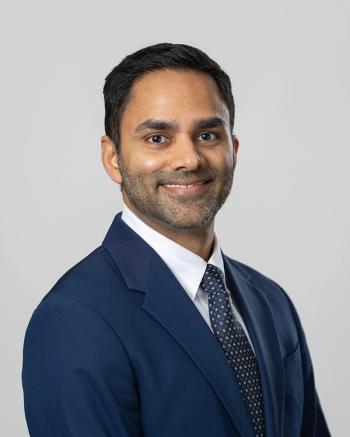
“To me, the biggest differentiator might be how the patient wants to experience care,” said Krish Patel, MD, on treatment options for patients with lymphoma.
“No one should be excluded from any clinical trial,” said Paul G. Rubinstein, MD, regarding patients with HIV-associated cancers in cooperative group studies.
People living with HIV have historically been excluded from many clinical trials assessing new cancer therapies, leaving open questions about how well modern regimens work in this population. Through the National Cancer Institute (NCI)–funded AIDS Malignancy Consortium (AMC), investigators have evaluated contemporary approaches in HIV-associated lymphomas. One example is the phase 1/2 AMC-085 trial (NCT01771107), a trial of brentuximab vedotin (Adcetris) plus doxorubicin, vinblastine, and dacarbazine (AVD) in HIV-associated Hodgkin lymphoma.1
CancerNetwork® spoke with Paul G. Rubinstein, MD, about how cooperative group research is improving outcomes for patients with HIV and lymphoma. Rubinstein is an associate professor in the Division of Hematology and Oncology and the Stewart D. Fordham Professor in Lymphoma at the University of Illinois College of Medicine at the University of Illinois Chicago (UIC). He is also a member of the Big Ten Cancer Research Consortium and the AMC.
Rubinstein began by explaining why multi-institutional networks are essential for studying this small patient population. He then discussed the safety considerations that shape trial design when novel agents are added to chemoimmunotherapy. Next, he described how outcomes have improved since the early years of the HIV epidemic and why drug-drug interactions still require close coordination among clinicians. He concluded with the push to bring CAR T-cell therapy and bispecific antibodies to patients living with HIV.
Rubinstein: My specialty is treating persons living with HIV and cancer. There are only about 1 million [patients] with HIV in the US, so the percentage of those who have cancer is quite small. It is very difficult to do this research at a single institution; in general, you can only do it with a large consortium.
Many of the newer agents that need to be tested have already been tested in the non-HIV population. But because this population is so small, it sometimes takes 5 or 6 years to complete 1 study. Having more people who will send patients, who will put patients on study, and who are seeing persons with HIV and cancer is the only way to answer the questions that are still pending in the field.
I was a coauthor on [the AMC-101 trial (NCT03220022)].2 The lead authors were Ida Wong-Sefidan, MD, at the University of California San Diego, along with Erin Reid, MD. Another example is the study of brentuximab vedotin plus AVD for Hodgkin lymphoma. For any of these trials, the questions are how advanced the patient’s HIV is and how to prevent infections during therapy. All these questions play a part in how you manage someone with HIV and cancer.
The therapies you mentioned, ibrutinib and rituximab, have already been used in the non-HIV population. The question is whether they work differently in the HIV population, [as] patients with HIV tend to be younger and have more comorbidities. We take all of this into consideration, especially how immunosuppressed patients are and whether they have advanced HIV.
The importance of the trials done by the AMC and the NCI network is that we do not just do trials in persons living with HIV. We do trials that include everyone from patients with the most advanced HIV to those living a fairly normal life with the infection, and designing these trials is complicated. That is why the AMC includes many of us across many hospitals, from Montefiore and Mount Sinai in New York to the University of California, San Francisco [UCSF] and the University of Illinois Chicago [UIC]. We design trials specifically to help treat these patients properly.
As for safety signals, the biggest [takeaway] is how advanced the patient’s HIV is. Patients with advanced HIV are more susceptible to certain infections, so you have to protect them more than others. But in general, in most of the trials we have done, outcomes are similar to those in the non-HIV population. If you protect patients from certain infections, the outcomes are the same.
I think that is the most important thing we have learned. If you treat someone living with HIV with a truncated chemotherapy regimen because you are afraid of infections, you are not doing the patient any service. We learned that by putting patients on study and showing that the outcomes are the same.
If you go back historically to the 1980s, there were not even HIV medications. Everyone was afraid to give full-dose chemotherapy, and survival for [patients with lymphoma] back then was a matter of months. Now, research from Dr Wong-Sefidan and Dr Reid has shown that survival for someone with AIDS-related or HIV-associated lymphoma is 83%.2 It is as good as in the non-HIV population.
That said, there are many issues with drug-drug interactions. Some HIV medications work by inhibiting the body’s ability to metabolize other medications; the HIV medications reach very high levels to control HIV. They can do the same with chemotherapy. With HIV medications that work that way, you have to be aware and take patients off them. I have had patients whom I had taken off these medications, and then their primary HIV physician put them back on, not knowing. There has to be very broad communication among all treating physicians.
The HIV epidemic is now concentrated in a few areas. For example, I volunteer at the county hospital in Chicago, where there is so much HIV that I have a clinic only for patients with HIV and cancer. That is not true at UIC. It is very important for patients to go to centers where clinicians see many of these patients, are aware of these interactions, and have trials that patients can enroll in. Those trials can improve outcomes or at least test whether these newer therapies are efficacious in someone living with HIV.
Unfortunately, many large cooperative group trials do not include [patients] with HIV because there are so few of them. But no one should be excluded from any clinical trial, and this is why organizations like the AMC are so important. Everyone deserves to be on a clinical trial, and every group deserves to have all these newer therapies tested.
With CAR T-cell therapy, for example, T cells are removed from your blood and sent out for what we call manufacturing. There, they are modified to attack the cancer, and they are reinfused into you at a later time. If you have HIV, the T cells removed from your blood are infected with HIV, so for a long time, no one wanted anyone with HIV to receive these therapies.
The phase 1 [AMC-115] trial [NCT05077527] is the first prospective study of CAR T-cell therapy in patients with HIV and relapsed/refractory lymphoma.3 Retrospective studies done by the AMC and by Stefan Barta, MD, showed that the efficacy is the same.4 Again, as I said before, the efficacy of most therapies used in the non-HIV population is similar in the HIV population. We just need the time and the patience to prove the point.
That goes for all new therapies, including bispecifics. The AMC will have a trial of a bispecific antibody plus chemotherapy for upfront DLBCL. The University of Illinois also has a trial of a BCMA-directed bispecific antibody in combination with chemotherapy for plasmablastic lymphoma. There is a lot of work to do, and unfortunately, it sometimes takes time when the population is so small.