



Hematologic Oncology
Latest News
Advertisement
Latest Videos






























































Advertisement
More News

The addition of tucidinostat to R-CHOP demonstrated promising safety and efficacy outcomes in patients with previously untreated diffuse large B-cell lymphoma) expressing MYC and BCL-2, according to interim analysis results.

Ongoing genomic profiling analyses in the ASC4FIRST trial may further determine which patients with CML may benefit from treatment with asciminib.

A reduction in splenomegaly was observed when the combination of pelabresib plus ruxolitinib was used to treat patients with myelofibrosis.

Ponatinib remains a safe treatment for patients with chronic-phase chronic myeloid leukemia.

Efficacy of post-transplant cyclophosphamide vs antithymocyte globulin remains a large discussion for patients with graft-vs-host disease.
ASTCT discusses Richter transformation and treatment options available for this population.
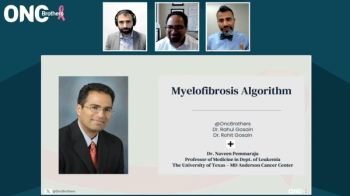
Naveen Pemmaraju, MD, discusses adverse effects associated with JAK inhibitors in the treatment of myelofibrosis, and the Oncology Brothers recap the entire discussion.
An expert on myelofibrosis discusses anemia and splenomegaly management practices for patients with myelofibrosis.
Naveen Pemmaraju, MD, gives a comprehensive overview of JAK inhibitors available for the treatment of patients with myelofibrosis.
A hematology specialist provides clinical insights on supportive care practices for patients with myelofibrosis.
Naveen Pemmaraju, MD, joins Rohit Gosain, MD, and Rahul Gosain, MD, to discuss diagnostic practices and prognostic factors for patients with myelofibrosis.
Investigators analyzed data from the Center for International Blood and Marrow Transplant Research who underwent autologous or allogeneic transplants.

Collaboration among nurses, social workers, and others may help in safely administering outpatient bispecific T-cell engager therapy to patients.
A mobile app may help to expedite treatment and identification for patients with GVHD.

One of the most important roles of a nurse coordinator is transmitting patient and caregiver information during the CAR T-cell treatment process.
Researchers at the University of Birmingham in the UK have explored the dynamics of inflammatory biomarkers following allogeneic hematopoietic stem cell transplantation.

A verbal tocilizumab workflow helped provide safer and more effective delivery of the agent for patients experiencing cytokine release syndrome.

The agency recommends that all patients receiving CAR T-cell products should be monitored life-long for secondary malignancy risks.

Pediatric patients with acute lymphoblastic leukemia/lymphoma were less likely to have severe COVID-19 infection.

Real-world data may serve as a benchmark for future studies in elderly patients with acute myeloid leukemia.
Dr. Mustafa Hyder spoke about the results from a phase 1/2 trial presented during the 2024 Tandem Meeting.

Findings suggest investigating an individualized monitoring period for stable patients with hematologic cancers to decrease financial and geographic barriers to CAR T-cell therapy.

In 2023, the FDA issued a warning on secondary primary malignancies after treatment with CAR T-cell therapy.
Jae Park, MD, discussed the use of CAR T-cell therapy across the hematologic malignancies space.
Findings from a study highlight that 7/8 mismatched unrelated donor posttransplant cyclophosphamide may be a suitable alternative treatment option for those with graft-vs-host disease.
Advertisement
Advertisement
Trending on CancerNetwork
1
Aglatimagene Combo Shows Sustained Immune Remodeling in Prostate Cancer
2
What Does TALAPRO-3 Mean for Frontline Treatment of HRR-Altered mHSPC?
3
SBRT Matches Chemoradiation, Preserves QOL Before Pancreatic Surgery
4
Tile-Based Radiation Improves Surgical Bed Recurrence in Brain Metastases
5