

An expert discusses how education about the clinical impact of genomic testing, understanding of targeted therapies, turnaround times, and team-based approaches are essential to bridge the gap in routine comprehensive genomic profiling adoption.

Your AI-Trained Oncology Knowledge Connection!
An expert discusses how education about the clinical impact of genomic testing, understanding of targeted therapies, turnaround times, and team-based approaches are essential to bridge the gap in routine comprehensive genomic profiling adoption.
An expert discusses how comprehensive genomic profiling panels that include relevant targets, resistance markers, and clonal hematopoiesis information have proven most useful, along with technologies that can detect fusion events, point mutations, and copy number variations for serial monitoring over time.
An expert discusses how molecular profiling has become essential for most solid tumor cancers, particularly in lung cancer, where both tissue- and plasma-based testing using next-generation sequencing help identify actionable genomic targets and monitor resistance patterns.
An expert discusses how molecular profiling has become essential for most solid tumor cancers, particularly in lung cancer, where both tissue- and plasma-based testing using next-generation sequencing helps identify actionable genomic targets and monitor resistance patterns.

Panelists discuss how improving CAR T accessibility through reduced monitoring requirements could strengthen its position against bispecific antibodies in treatment decision-making, emphasizing that access considerations should only influence therapy choice when efficacy and safety are comparable, not when CAR T demonstrates superior outcomes.

Panelists highlighted the impressive central nervous system activity of trastuzumab deruxtecan demonstrated in the DX12 trial, underscoring the need for multidisciplinary collaboration to optimize treatment of brain metastases and reduce reliance on whole-brain radiation, while acknowledging ongoing challenges in sequencing and patient selection amid evolving therapies.

Panelists discuss how successful outpatient bispecific therapy requires robust infrastructure, including 24-hour monitoring capabilities, emergency department coordination, and liberal use of supportive medications.
Panelists agreed that beyond third-line therapy for HER2-positive metastatic breast cancer, treatment becomes highly individualized—often described as the “wild West”—with options including various monoclonal antibodies, tyrosine kinase inhibitors, chemotherapy, and emerging agents; decisions are largely based on prior toxicities, patient preferences, and disease biology, with clinical trials playing a crucial role in offering promising new therapies that may outperform standard care.

Panelists discuss the sequencing of therapies in lower-risk myelodysplastic syndromes, debating whether to initiate treatment with erythropoiesis-stimulating agents due to cost and patient variability or with luspatercept for its superior efficacy and potential disease-modifying effects, while highlighting ongoing trials exploring combined or sequential strategies.
Panelists highlighted that the HER2CLIMB study showed adding tucatinib to trastuzumab and capecitabine provides a meaningful progression-free survival benefit in HER2-positive metastatic breast cancer with brain metastases, balancing improved intracranial control against manageable toxicities like diarrhea and hand-foot syndrome, and underscored the importance of patient education and dose management to maintain adherence and quality of life.
Panelists discuss how findings from a Mayo Clinic retrospective study demonstrate the feasibility and safety of outpatient step-up dosing for talquetamab, with minimal hospitalizations required.
Panelists discuss treatment strategies for lower-risk myelodysplastic syndromes guided by serum erythropoietin (EPO) levels, weighing the reduced efficacy of erythropoiesis-stimulating agents at higher EPO levels against newer therapies’ benefits and challenges, and emphasizing personalized sequencing based on patient and disease characteristics.

Panelists discuss the critical role of sequencing B-cell maturation antigen (BCMA)-targeted therapies in multiple myeloma, emphasizing that administering chimeric antigen receptor (CAR) T-cell therapy before bispecific antibodies leads to better outcomes, while real-world evidence and emerging guidelines increasingly inform strategic decisions based on treatment timing, disease urgency, and patient-specific factors.
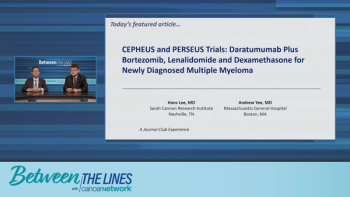
Panelists discuss updated American Society of Clinical Oncology (ASCO) data confirming that daratumumab-based quadruplet therapy (Dara-VRD) significantly improves progression-free survival (PFS) and sustains minimal residual disease (MRD) negativity in patients with newly diagnosed transplant-eligible multiple myeloma, reducing early relapses and reinforcing this regimen as the evolving standard of care with potential for unprecedented long-term outcomes.
Panelists discuss the Perseus study, which compared daratumumab-based quadruplet therapy (Dara-VRD) with VRD alone in patients with newly diagnosed, transplant-eligible multiple myeloma, highlighting its focus on a generally fit population and demonstrating improved progression-free survival and deeper responses with the 4-drug regimen, while noting some limitations in applicability to patients with significant comorbidities.
Panelists discuss the emerging real-world use of talquetamab as a bridging therapy before chimeric antigen receptor (CAR) T-cell treatment in patients with advanced multiple myeloma, highlighting its ability to rapidly reduce tumor burden and improve CAR T outcomes despite unique toxicities and emphasizing how clinician-driven innovation is shaping practice ahead of clinical trial data.

The CHALLENGE trial in CRC studied structured exercise and demonstrated a DFS benefit comparable to or exceeding oxaliplatin chemotherapy.

According to Jorge Nieva, MD, there are a multitude of things that can be explored to enhance the treatment landscape for lung cancer.

Panelists discuss how the availability of multiple B-cell maturation antigen (BCMA) bispecific agents (with linvoseltamab approved in Europe and other agents in development) creates beneficial competition that could drive down costs and provide more treatment options, while acknowledging that safety and efficacy profiles appear comparable across agents, making accessibility and convenience key differentiating factors for patient care.
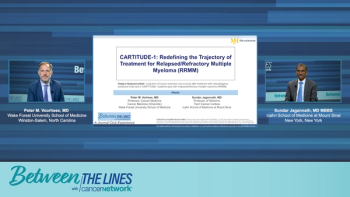
Panelists discuss how the baseline characteristics of CARTITUDE-1 participants underscore the trial’s focus on patients with heavily pretreated and refractory disease.
Panelists discuss how recent long-term follow-up data for teclistamab and elranatamab reaffirm their effectiveness in relapsed/refractory multiple myeloma (R/R MM) with no new safety signals, while emphasizing that direct comparisons between B-cell maturation antigen (BCMA) bispecifics may not be fair due to evolving mitigation strategies, improved supportive care practices, and different study conditions including the impact of COVID-19 on early trials.
Panelists discuss how the CARTITUDE-1 trial was designed to evaluate cell therapy in relapsed/refractory multiple myeloma and the importance of long-term follow-up in understanding efficacy and safety.

Taletrectinib showed improved efficacy in patients with ROS1-positive non–small cell lung cancer who were treatment-naïve.

“It’s a drug that I’m very comfortable with, and it is a drug I’ll likely use primarily in the first-line setting,” stated Jorge Nieva, MD, on taletrectinib in non–small cell lung cancer.
Panelists discuss how both amivantamab plus lazertinib and osimertinib-based regimens show good central nervous system activity for patients with baseline brain metastases, with treatment choice influenced more by patient-specific factors like bleeding risk and anticoagulation contraindications than by CNS efficacy differences.
Panelists discuss how the MARIPOSA study demonstrated significant progression-free survival and overall survival (OS) benefits with amivantamab plus lazertinib vs osimertinib monotherapy, with mature overall survival data showing a 25% improvement in survival outcomes.

Those being treated for peritoneal carcinomatosis may not have to experience the complication rates or prolonged recovery associated with surgical options.
For patients with peritoneal carcinomatosis, integrating PIPAC into a treatment regimen does not interrupt their systemic therapy.
Panelists discuss the debate on optimal timing for initiating therapies in lower-risk myelodysplastic syndromes, balancing early intervention to improve quality of life and prevent complications against a conservative approach favoring treatment initiation upon transfusion dependency or symptom onset.
Panelists emphasized that for a patient with metastatic HER2-positive breast cancer and active brain metastases, selecting a treatment with proven intracranial activity is critical, while carefully considering prior therapy tolerability, radiation history, and the balance between treatment efficacy and patient convenience to optimize both disease control and quality of life.