
Goutham Vemana, MD, explained how the intravesical system provides continuous treatment exposure, deeper bladder penetration, and zero systemic absorption.
Goutham Vemana, MD, explained how the intravesical system provides continuous treatment exposure, deeper bladder penetration, and zero systemic absorption.
Joshua Richter, MD, and Marco Davila, MD, PhD, weighed in on sequencing CAR T-cell therapy and bispecifics in multiple myeloma.

Kim Stravers, an end-of-life doula, discussed how she helps patients assert autonomy over end-of-life medical decisions, including pain management preferences.
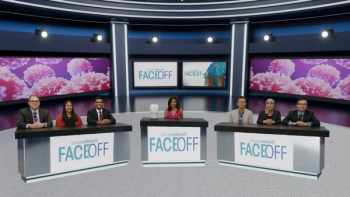
Jun Gong, MD, presents the EMERALD-1 trial for Team Chicago Hot Dog, reviewing the phase 3, randomized, double-blind study of transarterial chemoembolization (TACE) with durvalumab, with or without bevacizumab, in unresectable hepatocellular carcinoma (HCC) amenable to embolization.
The panel discusses whether the SIERRA safety data support using the STRIDE regimen, tremelimumab plus durvalumab, in patients typically excluded from frontline hepatocellular carcinoma (HCC) trials.
Joshua Richter, MD, and Marco Davila, MD, PhD, weighed in on the optimal timing of CAR T-cell therapy for multiple myeloma.
Kim Stravers, an end-of-life doula, defined the role as a non-medical companion offering emotional and relational support to patients and their families.
Mamta Parikh, MD, MS, outlined strategies to overcome payer coverage friction and optimize ctDNA testing windows after cystectomy.

A multidisciplinary panel broke down ILC's distinct biology, imaging challenges, and emerging trial data, including OFSET and SUMMIT.
Adam D. Cohen, MD, said that more data are necessary to help determine how cevostamab can be sequenced with other T-cell–directed therapies.
Mamta Parikh, MD, MS, contextualized recent NCCN updates on ctDNA MRD testing after radical cystectomy in muscle-invasive bladder cancer.
Following the presentation of the CARTITUDE-4 trial, the faculty discuss how the study findings may influence treatment strategies for relapsed/refractory multiple myeloma (R/R MM).
Dr. Cesar Rodriguez presents findings from the phase 3 CARTITUDE-4 trial, which compared ciltacabtagene autoleucel (cilta-cel) with standard-of-care regimens in patients with relapsed/refractory multiple myeloma (R/R MM) who were refractory to lenalidomide after one to three prior lines of therapy.
Adam D. Cohen, MD, says patients with deep responses to cevostamab could stop therapy and stay in remission for years.
Ramy Sedhom, MD, blind-ranks landmark geriatric oncology and palliative care trials, picks his oncology Hall of Fame, and shares career advice on this episode of Double Blind.
Dr. Lipsky presents a second case of a 72-year-old man with symptomatic CLL requiring therapy.
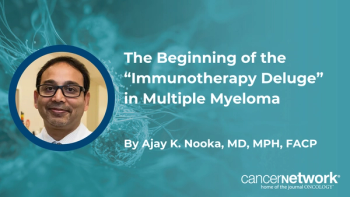
Ajay K. Nooka, MD, MPH, FACP, says multiple myeloma treatment is entering an immunotherapy deluge, with more data on bispecifics ahead.
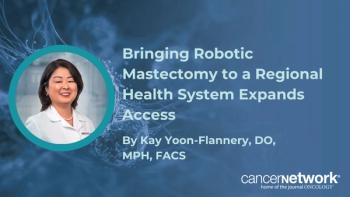
Kay Yoon-Flannery, DO, spoke about how offering robotic mastectomy locally at AtlantiCare improved patient access.
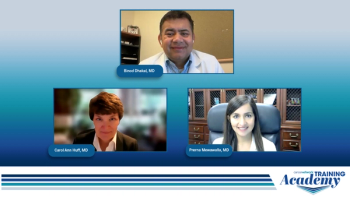
Building on the first patient case, Dr. Binod Dhakal and Dr. Prerna Mewawalla discuss how recently presented MajesTEC-9 data may influence treatment selection for patients with relapsed/refractory multiple myeloma (RRMM) who experience an early relapse following frontline therapy.
Using a case-based scenario, Dr. Binod Dhakal and Dr. Carol Ann Huff explore treatment decision-making for a fit patient with relapsed/refractory multiple myeloma (RRMM) experiencing first relapse approximately 30 months after autologous stem cell transplantation.
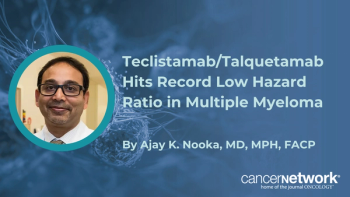
Ajay K. Nooka, MD, MPH, FACP, says the teclistamab-talquetamab combination reduced progression risk by 89% in MonumenTAL-6.
Kay Yoon-Flannery, DO, MPH, FACS, described why the lateral axillary line is her preferred incision site for single-port robotic mastectomy.
Frank McCormick, PhD, FRS, DSc (Hon), outlined the rationale for combining KRAS inhibitors with PI3K and checkpoint inhibitors to improve durability of response.
Frank McCormick, PhD, FRS, DSc (Hon), discussed how RASolute-302 data showing daraxonrasib nearly doubled survival reshaped pancreatic cancer drug development.
Stay tuned for an in-depth discussion on navigating operational workflows and mitigating barriers to access for CAR T-cell therapy in multiple myeloma.
The faculty open the episode by discussing how most patients with hormone receptor-positive, HER2-negative metastatic breast cancer begin treatment with a CDK4/6 inhibitor plus an aromatase inhibitor and many respond well, sometimes for years.

Kay Yoon-Flannery, DO, MPH, FACS, explained how the da Vinci Single Port 3D visualization improves precision vs open or multiport surgery.
James J. Harding, MD, presents the SIERRA study for Team Deep-Dish Pizza, reviewing the phase 3b, single-arm trial of the STRIDE regimen, tremelimumab plus durvalumab, in first-line unresectable hepatocellular carcinoma (HCC) with poor-prognosis features.
Zahra Mahmoudjafari, PharmD, BCOP, FHOPA, MBA, predicts operational challenges as CAR T-cell therapy expands to non-oncology indications.
María Teresa Bourlon, MD, MSc, FASCO, discussed why early RadiCal trial closure and adverse effects outweigh secondary survival signals in bone-metastatic RCC.