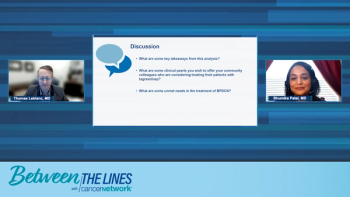
An overview of what’s next, in terms of the use of various frontline treatment regimens, that include novel agents to manage patients with newly diagnosed multiple myeloma.

Your AI-Trained Oncology Knowledge Connection!


An overview of what’s next, in terms of the use of various frontline treatment regimens, that include novel agents to manage patients with newly diagnosed multiple myeloma.

Recommendations regarding best approaches to using novel therapies to treat multiple myeloma based on current drug approvals as well as new therapies in the pipeline.

Treatment options available for an elderly man with multiple myeloma upon first relapse.

Advice for community physicians treating HER2+ breast cancer.

Ghassan K. Abou-Alfa, MD, examined the trial design of the phase 3 HIMALAYA trial of tremelimumab plus durvalumab for frontline hepatocellular carcinoma, with results presented at the 2022 Gastrointestinal Cancers Symposium.

Amitkumar Mehta, MD, detailed encouraging data presented at the 63rd ASH Annual Meeting for treating mantle cell lymphoma.

Michael R. Bishop, MD, discussed how he thinks the results from phase 3 BELINDA study may impact the treatment landscape in B-cell lymphomas moving forward.

Experts provide commentary on the subgroup analyses from real-world data on use of ixazomib, lenalidomide, and dexamethasone compared with lenalidomide and dexamethasone in patients with relapsed/refractory multiple myeloma.

Dr. Virginia Kaklamani discusses the role of maintenance therapies for HER2+ breast cancer.

Virginia Kaklamani, MD, DSc, provides an overview of the goals of care for HER2+ breast cancer.

What needs to be investigated further before adopting MRD assessments for multiple myeloma into routine clinical practice.

Considerations for selecting between a conventional front-line triplet regimen to manage a patient with high-risk multiple myeloma who is ineligible for transplant vs a new quadruplet regimen, as demonstrated in recent clinical trial data.

Zev A. Wainberg, MD, discusses future research efforts for the treatment of patients with advanced gastric cancer.

Drs Agarwal and Chowdhury discuss future directions for mCSPC, including potential use of triplet combination therapy.

Ghassan K. Abou-Alfa, MD, detailed the evolution of treatment options for unresectable hepatocellular carcinoma prior to the phase 3 HIMALAYA study and the reasons for launching the trial.

Michael R. Bishop, MD, discussed details from the ZUMA-7 and TRANSFORM trials that were presented at the 63rd ASH Annual Meeting.

Michael R. Bishop, MD, highlighted the population of patients with relapsed/refractory B-cell non-Hodgkin lymphoma who were enrolled on the phase 3 BELINDA study and treated with tisagenlecleucel.

Suzanne Fanning, DO, and Joshua Richter, MD discuss efficacy outcomes seen in a routine clinical practice study of ixazomib, lenalidomide and dexamethasone [IRD] compared with lenalidomide and dexamethasone [Rd] in patients with relapsed/refractory multiple myeloma.

A review of the currently available frontline treatment options for HER2+ breast cancer.

Virginia Kaklamani, MD, DSc, provides an overview of the goals of care for HER2+ breast cancer.

Various considerations affect choice of first-line therapy for a patient with newly diagnosed multiple myeloma who is ineligible for transplant.

An overview of treatment regimens available for patients with newly diagnosed multiple myeloma who are ineligible for stem cell transplantation.

Amitkumar Mehta, MD, discusses overall response rates from the CITADEL-205 study looking at parsaclisib for patients with relapsed/refractory mantle cell lymphoma.

Interesting questions raised by a paper that compared the use of 18F-fluciclovine with 68Ga-PSMA-11 imaging modalities to detect biochemical relapse in prostate cancer and implications for integrating newer techniques into clinical practice.

Genitourinary oncology experts share key takeaways and considerations for treating patients with metastatic castration-sensitive prostate cancer.

CancerNetwork® spoke with Phillip Low, PhD, about the development and FDA approval of pafolacianine.

Zev A. Wainberg, MD, spoke to the rationale for examining the efficacy of pembrolizumab alone and in combination with chemotherapy for patients with advanced gastric and gastroesophageal junction adenocarcinoma.

Yael Cohen, MD, sat down with CancerNetwork® to discuss how the multiple myeloma space is entering into an era of CAR T-cell therapy.

Yael Cohen, MD, discusses safety data from a clinical trial assessing the use of ciltacabtagene autoleucel in lenalidomide-refractory multiple myeloma.

CancerNetwork® spoke with Rafael Fonseca, MD, about future efforts to compare use of daratumumab-containing regimens as either frontline or second-line therapy in patients with multiple myeloma that are transplant ineligible.