

The use of bioimpedance spectroscopy takes under 2 minutes and can help detect lymphedema before symptoms appear.
The use of bioimpedance spectroscopy takes under 2 minutes and can help detect lymphedema before symptoms appear.
Experts discuss the significance of event-free survival and overall survival in cancer trials, emphasizing patient quality of life and treatment decisions.
Experts discuss the significance of event-free survival and overall survival in cancer trials, emphasizing the importance of patient quality of life.

Clinicians who are experienced with immunotherapy, like durvalumab, can easily identify and manage AEs associated with treatment for gastric/GEJ cancer.
Based on results from the MATTERHORN study of durvalumab/FLOT in gastric/GEJ cancers, the regimen should be considered a new SOC.
Yelena Y. Janjigian, MD, provides the background of the MATTERHORN trial, showcasing the importance of durvalumab plus FLOT in gastric/GEJ cancers.
Oncologists discuss effective strategies for safely implementing combination therapies while managing adverse events to enhance patient outcomes.
Experts discuss the efficacy of amivantamab and lazertinib in treating EGFR mutations, highlighting improved outcomes and reduced CNS metastases.
Kandance P. McGuire, MD, FACS, breaks down what lymphedema is and why it may be detected later.
Doctor Fontaine discusses the importance of patient selection for preoperative chemotherapy and the effectiveness of immune checkpoint inhibitors in surgery outcomes.
Experts discuss the challenges and strategies in managing patients with inadequate responses to preoperative cancer treatments, emphasizing the need for clinical trials.
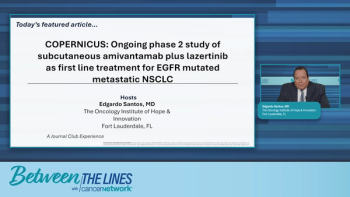
This opening section introduces the COPERNICUS study and frames it within the evolving treatment landscape for EGFR-mutated metastatic non–small cell lung cancer.
Panelists review the final analysis of the ZUMA-7 study evaluating axi-cel versus salvage chemotherapy followed by transplant. Discussion focuses on long-term event-free survival, progression-free survival, and overall survival outcomes. Faculty also assess the safety profile and implications for positioning CAR T as a preferred second-line strategy.
Panelists discuss long-term outcomes from the TRANSFORM study evaluating liso-cel in second-line relapsed/refractory LBCL. The conversation highlights durability of response, progression-free and overall survival trends, and updated safety findings presented at the American Society of Hematology Annual Meeting 2025. Faculty consider how extended follow-up informs expectations for long-term remission with CAR T therapy.

Panelists discuss how sequencing targeted therapies after CDK4/6 inhibitors differs for patients with actionable mutations versus those without, incorporating evidence for rechallenge and combination strategies.

Explore the evolving landscape of high-risk smoldering myeloma treatment options and the challenges in patient management and risk assessment.
Explore the differences between bispecific antibodies and CAR T-cell therapy, highlighting their unique benefits and administration processes in cancer treatment.

Explore the differences between bispecific antibodies and CAR T-cell therapy, highlighting their unique benefits and administration processes in cancer treatment.

Panelists discuss how pivotal trials and real-world evidence have reinforced CAR T-cell therapy’s high response rates, deep remissions, and durable outcomes in relapsed/refractory multiple myeloma.
Explore the evolving treatment strategies for high-risk smoldering multiple myeloma, emphasizing early intervention and recent clinical advancements.
Panelists discuss how integrating both tissue and liquid genomic testing at diagnosis and progression improves detection of tumor heterogeneity and informs personalized treatment decisions in metastatic breast cancer.
Experts discuss the rapid advancements in BCMA-directed bispecific antibodies for relapsed/refractory multiple myeloma, highlighting improved response rates and treatment integration.
Explore the latest advancements in oral hypomethylating agents for MDS and CMML, emphasizing their efficacy, patient convenience, and treatment strategies.
Findings from David Rimm, MD, PhD, suggest that there may be an inverse relationship between HER2 and TROP2 expression among patients with breast cancer.
A pathologist is often needed to definitively diagnose a patient with cancer based on the tissue testing results.
Tissue samples collected from patients with breast cancer during treatment may help explore therapy selection and predict toxicities.
Clinicians can reduce doses and mitigate toxicities in an easier fashion when administering elacestrant-based treatment for those with advanced breast cancer.
The experts focus on clinical trial evidence supporting the use of combination therapies in EGFR-mutant mNSCLC. The panel reviews key data from the MARIPOSA and FLAURA trials, highlighting differences in patient populations, CNS imaging protocols, and reported outcomes. They emphasize that routine CNS surveillance allows for a more accurate assessment of intracranial progression-free survival and can inform optimal therapy selection. MARIPOSA trial data demonstrate that amivantamab plus lazertinib significantly improves intracranial progression-free survival compared to osimertinib monotherapy, effectively doubling outcomes in patients with baseline brain metastases. The discussion also addresses the importance of patient stratification based on risk factors, including high tumor burden, liver metastases, p53 mutations, and circulating tumor DNA levels, which may impact prognosis and response to therapy. The panel emphasizes that combination therapy is beneficial across populations, not limited to high-risk patients, and stresses the significance of first-line therapy selection in improving long-term outcomes. Safety profiles and tolerability are also introduced, noting the need for patient education and shared decision-making.