
An overview of the rationale and study design of the INTERCEPT study in patients with colorectal cancer, with a focus on the early key findings.
An overview of the rationale and study design of the INTERCEPT study in patients with colorectal cancer, with a focus on the early key findings.

Pegulicianine-guided breast cancer surgery may allow practices to de-escalate subsequent radiotherapy, says Barbara Smith, MD, PhD.
A long commute can significantly impact your work-life balance, according to Mary-Ellen Taplin, MD.
Adrienne Bruce Shannon, MD, discussed ways to improve treatment and surgical outcomes for patients with dMMR gastroesophageal cancer.
The panel discusses key learnings from recent studies in non-clear cell RCC subtypes and the need to better understand disease biology to develop optimized, histology-specific therapies rather than extrapolating clear cell treatment approaches.
Barbara Smith, MD, PhD, spoke about the potential use of pegulicianine-guided breast cancer surgery based on reports from the phase 3 INSITE trial.
Mary-Ellen Taplin, MD, spoke about working in genitourinary oncology and how she has maneuvered the field as a woman.

Lymphedema is a common adverse effect and may negatively impact a patient’s body image.

Patient-reported symptoms following surgery appear to improve with the use of perioperative telemonitoring, says Kelly M. Mahuron, MD.
Lymphedema is an adverse effect associated with breast cancer treatment, and patients should be monitored for these symptoms.

Treatment options in the refractory setting must improve for patients with resected colorectal cancer peritoneal metastasis, says Muhammad Talha Waheed, MD.
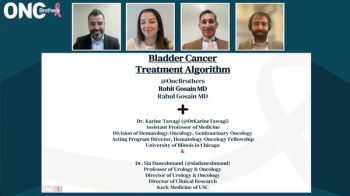
The Oncology Brothers recap the discussion on treatment practices for patients with bladder cancer.
Focusing on the metastatic setting, the expert panel discusses advanced kidney cancer treatment practices, highlighting recent data that are informing treatment decisions.
Karine Tawagi, MD, and Sia Daneshmand, MD, offer comprehensive insights on treatment practices for patients with muscle-invasive bladder cancer.
Sia Daneshmand, MD, and Karine Tawagi, MD, join Rahul Gosain, MD, and Rohit Gosain, MD, to discuss the treatment algorithm for non–muscle-invasive bladder cancer.
Cancer vaccines are a “cross-cutting approach” that may be applicable across several cancer types, according to Catherine J. Wu, MD.
Although immature, overall survival data from the KEYNOTE-868 trial may support the use of pembrolizumab plus chemotherapy in patients with endometrial cancer.

Focusing on patient education, the panel outlines resources available to help patients with multiple myeloma navigate their treatment journey.
Arvind N. Dasari, MD, MS, presents the third patient profile of the discussion, a 62-year-old woman with colon cancer, highlighting the role of MRD testing in guiding treatment decisions in the surveillance setting.
Stacey Cohen, MD, reviews the initial results from the phase 2 COBRA study focused on ctDNA as a predictive biomarker in adjuvant chemotherapy for patients with stage II colon cancer.
A panel of experts on multiple myeloma review a patient profile, offer their initial impressions, and highlight the role of an advanced practice provider.
Dostarlimab plus chemotherapy appears to yield favorable overall survival in patients with mismatch repair proficient endometrial cancer.
Martin Voss, MD, reviews data updates from ASCO GU 2024 on the KEYNOTE-B61 study of lenvatinib + pembrolizumab in nccRCC in addition to real-world outcomes in patients with chromophobe RCC.
mRNA may be a potential modality for developing cancer-based vaccines, according to Catherine J. Wu, MD.
Panelists discuss systemic therapy approaches for RCC patients presenting with brain, liver, or bone metastases, noting more limited efficacy of IO-IO therapy in brain metastases and tendencies to use IO-TKI therapy for aggressive or rapidly progressing disease.
Final remarks and presentation of awards.

Some patients with large B-cell lymphoma may have to travel a great distance for an initial evaluation for CAR T-cell therapy.
Brian Slomovitz, MD, MS, FACOG discusses the use of new antibody drug conjugates for treating patients with various gynecologic cancers.
Analyzing the KRAS mutation across various cancer types may be a worthwhile target when using a cancer vaccine or immunotherapy, says Catherine J. Wu, MD.
Education is essential to referring oncologists manage toxicities associated with CAR T-cell therapy for patients with large B-cell lymphoma.