

A second case illustrates clinical decision-making after progression on osimertinib, highlighting diagnostic re-biopsy and ctDNA testing.
A second case illustrates clinical decision-making after progression on osimertinib, highlighting diagnostic re-biopsy and ctDNA testing.

Martin F. Dietrich, MD, PhD, explains how NALIRIFOX dosing in the NAPOLI 3 trial resulted in lower rates of grade 3/4 neutropenia vs standard therapy for metastatic PDAC.
The conversation shifts to how dual EGFR-MET inhibition reduces resistance mutations and molecular heterogeneity compared with osimertinib monotherapy.
The NAPOLI 3 trial demonstrated that NALIRIFOX improved outcomes for patients with metastatic pancreatic ductal adenocarcinoma compared with the standard of care, nab-paclitaxel and gemcitabine.
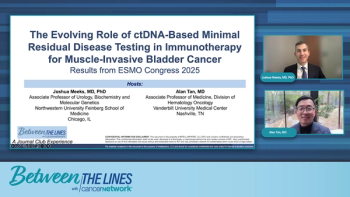
The panelists propose a nuanced view of molecular testing, suggesting ctDNA's value lies in its positive predictive capacity for identifying advanced disease, while utDNA may offer stronger negative predictive insights.
Drs. Meeks and Tan explore the SunRISe-4 trial, highlighting its innovative combination of intravesical therapy and immunotherapy.

Because EVA1 is not expressed in normal cells, there may be less toxicity when targeting it to eliminate glioblastoma-initiating cells.

Sonia Jain, PhD, stated that depatuxizumab mafodotin, ABBV-221, and ABBV-321 were the 3 most prominent ADCs in EGFR-amplified glioblastoma.
Panelists discuss how daratumumab plus KRd demonstrates manageable toxicity and strong real-world feasibility with appropriate supportive care.
Panelists discuss how ADVANCE findings support the use of quadruplet therapy in both transplant-eligible and -ineligible patients with NDMM.
Skin toxicities are common with targeted therapies for GI malignancies but can be remedied by preventive measures and a collaboration with dermatology.

Computational models help researchers anticipate how ADCs may behave in later lines of development, while they are still in the early stages.

Presents MARIPOSA trial results showing superior progression-free survival and overall survival with amivantamab plus lazertinib.

ADC payloads with high levels of potency can sometimes lead to higher levels of toxicity, which can eliminate the therapeutic window for patients with cancer.

According to Greg Thurber, PhD, target-mediated uptake is the biggest driver of efficacy for antibody-drug conjugates as a cancer treatment.
Panelists explore the latest insights on CTDNA in muscle-invasive bladder cancer and its impact on immunotherapy decision-making and patient outcomes.
Panelists discuss new findings on adjuvant immunotherapy for high-risk bladder cancer revealing significant insights into patient outcomes and treatment strategies.
The panel reviews components of the COCOON prophylactic regimen and the safe use of temporary dose modifications to maintain adherence.
Discussion centers on early dermatologic AEs with amivantamab plus lazertinib, emphasizing prevention protocols and staff education.

Panelists discuss how the decision to offer local consolidative therapy in oligometastatic non–small cell lung cancer depends on multiple factors including PET scan activity at 6 months, the feasibility of rendering patients with no evidence of disease, multidisciplinary collaboration, and the emerging need for a “third box” treatment category beyond curative and palliative intent that addresses preemptive strikes against limited progressive sites to prolong survival.

Combining daratumumab with other agents is one strategy that investigators are exploring in the smoldering multiple myeloma field.

Antibody-drug conjugates are effective, but strategies such as better understanding the mechanisms of action may lead to enhanced care for patients with cancer.

Co-hosts Kristie L. Kahl and Andrew Svonavec highlight what to expect at the 43rd Annual Chemotherapy Foundation Symposium, such as new chemotherapeutics and targeted therapies.
A substantial portion of patients who received daratumumab in the AQUILA study were able to delay disease progression to active multiple myeloma.
Panelists discuss how ADVANCE results show daratumumab-based quadruplets achieve high MRD negativity across risk and age groups in NDMM.
Panelists discuss how the ADVANCE trial’s inclusive design and MRD-based end points make it a model for future NDMM research.

Results showed no “deleterious reactions” with chlorotoxin-directed cellular therapy in a small cohort of patients with recurrent glioblastoma.

Although 1 of 21 patients with liver-dominant NETs died due to RILD in the phase 1 study, no RILD-induced deaths were observed in the phase 2 trial.
A novel CAR T-cell therapy may bind with more avidity, rather than affinity, to glioblastoma cells, said Michael Barish, PhD.