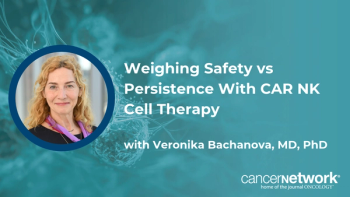
Veronika Bachanova, MD, PhD, discussed how the favorable safety profile of CAR natural killer cell therapies may come with trade-offs in persistence and response durability.
The FDA approval of Orca-T represents an “important advance” in the world of allogeneic transplant, according to Wendy Stock, MD.
On June 30, 2026, the
In an interview with CancerNetwork®, Wendy Stock, MD, the Anjuli Seth Nayak Professor of Medicine, cochair of the Leukemia Committee for the National Cancer Institute–supported Alliance for Clinical Trials in Oncology, and coleader of the Clinical and Experimental Therapeutics Research Program at the University of Chicago Medicine Comprehensive Cancer Center, discussed what the approval validates conceptually about engineering the allograft itself. She also highlighted how it may reshape the way clinicians think about the graft as a modifiable product rather than something that is simply infused.
Transcript:
CancerNetwork: What does this approval validate conceptually? Does it change how clinicians should think about the allograft as a drug that can be engineered rather than just infused?
Stock: It does give us some validation of many years of work that has been ongoing to try to manipulate the graft in order to improve outcomes for patients undergoing allogeneic transplant, where the big risks are relapse and graft-versus-host disease, which sometimes go hand in hand because of the complications that occur after allogeneic transplant: the need for more immunosuppression, and then the increased risk of relapse.
I do think this is an important advance, along with other things that have been progressing in the world of allogeneic transplant, other manipulations that do not always have to do with graft engineering. But this shows and validates that graft engineering is possible, and is possible in a successful manner to improve outcomes for patients undergoing allogeneic transplant.