Allen Khodab, MD discussed how patients with larger prostates had reduced IPSS scores that normalized to the same level as those with normal-sized glands.
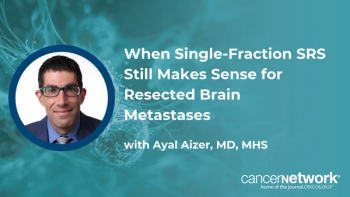
Ayal Aizer, MD, MHS, describes an adaptive planning trial using synthetic CT to improve same-day treatment accuracy for anatomically unstable brain metastases.
Precision is central to stereotactic radiosurgery, but some brain metastases present a unique planning challenge: Their position can shift between the time imaging is obtained and the time treatment is delivered. This can occur when a tumor is growing quickly, when a nearby surgical cavity is contracting, or when swelling near an unstable metastasis is pushing it out of place. In any of these scenarios, there is a risk that the tumor may not be exactly where the treatment plan expects it to be on the day of treatment.
Ayal Aizer, MD, MHS, describes an adaptive planning trial currently accruing at Dana-Farber Cancer Institute that is designed to address this challenge. The trial uses the diagnostic MRI that a patient already receives to build a synthetic CT and generate a treatment plan. This allows patients to be mapped and treated on a linear accelerator on the same day, within just a few hours, reducing the work required once the patient arrives for planning. He also shares his center's longer-term goal for this approach: eventually moving from a diagnostic MRI directly to the treatment table.
At the 2026 SNO ASCO CNS Metastases Conference in Boston, Massachusetts, Aizer discussed advancements in the stereotactic management of brain metastases in recent years. Aizer, senior physician and director of central nervous system radiation oncology at Dana-Farber Cancer Institute, and associate professor of radiation oncology at Harvard Medical School, spoke with CancerNetwork® at the conference about this presentation.
Transcript:
Aizer: One trial that we're really excited about, that's accruing now at our center, is an adaptive planning trial. The idea is that we're taking tumors that are [anatomically] volatile, meaning they're growing rapidly or they're prone to soft tissue shifts… Maybe there's an intact tumor, and there's a surgical cavity that was recently made nearby, and you worry that between planning and treatment, that intact tumor could move after the surgical cavity contracts. Maybe there's a large amount of edema near a metastasis that's unstable, and it could be pushing it one way or another. It all boils down to the concern that the metastasis may not be in the exact location you think it is when you treat.
We have an adaptive trial in which patients can be treated on a linear accelerator on the same day as radiation, just a few hours after they come in for mapping. What's really being done is we're taking the diagnostic MRI that leads to treatment, the one done in radiology, and making a synthetic CT. We're able to use that diagnostic MRI to create a pre-plan, so that when the patient comes in on the actual planning day, much less has to be done. It's all these new workflows, algorithms, and synthetic CT that have made it possible. Our hope is that in a few years, we can go from diagnostic MRI directly to the treatment table, but we're not there yet. That's something we're actively working on.
Aizer A. Advances in the stereotactic management of brain metastases. Presented at: 2026 SNO ASCO CNS Metastases Conference; August 13-15, 2026; Boston, MA.