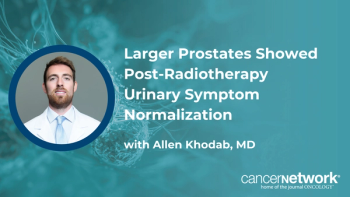
Allen Khodab, MD discussed how patients with larger prostates had reduced IPSS scores that normalized to the same level as those with normal-sized glands.
Leveraging 6-month PSA and PSMA-PET metrics may guide therapy escalation or de-escalation in metastatic hormone-sensitive prostate cancer.
At the
While achieving a prostate-specific antigen (PSA) level of less than or equal to 0.2 ng/mL at 6 months remains a powerful prognostic indicator for long-term survival, Praful suggested that persistent, PSMA-avid disease remains detectable in all patients, regardless of their biochemical response. Specifically, Ravi discussed the “million-dollar question” facing clinicians: how to leverage this 6-month milestone using both PSA metrics and advanced PET imaging to intelligently guide treatment escalation or de-escalation strategies.
Ravi: That is the million-dollar question. Because the question is: what do you do with this information now? One way you could take this forward is we know that 6-month PSA is highly prognostic. We know those patients who don't achieve a low PSA are destined to do poorly––their median survival is 3 or 4 years compared with those who achieve that low PSA, whose median survival is 8 or 9 years. So, there is a big discrepancy there.
Now, could you invoke a scenario where you get a PET scan at 6 months, and you use the PSA and the PET scan to decide escalation or de-escalation? If you have a favorable PSA of less than 0.2 and limited disease on the PET scan, maybe that could facilitate a de-escalation strategy where you stop therapy after a while. Those trials are ongoing. Maybe you could even use the PET scan to add [stereotactic body radiation therapy] potentially to those with residual disease, to potentiate that deep response.
But really, where it gets interesting is in the patients with a PSA above 0.2. We know they have a lot of PSMA-avid disease. We know that disease is avid and hot. Really, the question there becomes: can you intensify with a PSMA radiopharmaceutical therapy, a PSMA ADC, or a PSMA-targeted therapy? That would really be the question, or the trial to look at, to say: can that early intervention at 6 months—when the patient is not progressing, but they have not achieved that great response—can you escalate therapy at 6 months in those who have PSMA-avid disease and demonstrate improved outcomes compared with the standard of care, where we know these patients are unfortunately not going to live past an average of around 3 years?
Ravi P, Shah H, Liu M, et al. Quantitative results from PSMAtrack: a prospective study evaluating changes in PSMA-PET during initial systemic therapy for metastatic hormone-sensitive prostate cancer (mHSPC). J Clin Oncol. 2026;44(suppl 16):5182. doi:10.1200/JCO.2026.44.16_suppl.5102