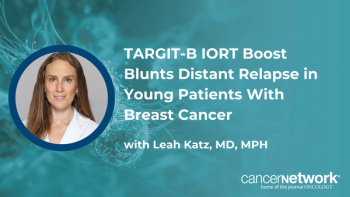
Leah Katz, MD, MPH, explained how an intraoperative tumor bed boost in TARGIT-B may reduce distant relapse in young patients with breast cancer.
Long-term follow-up from the phase 3 RUBY trial revealed a 54% estimated cure rate with the dostarlimab combination in dMMR/MSI-H primary advanced or recurrent endometrial cancer.
At the
With a median follow-up of 55.6 months, approximately 2.5 additional years of observation beyond the trial's primary analysis, the dMMR/MSI-H population treated with dostarlimab plus CP demonstrated PFS stability, with 4 new progression events observed during the extended follow-up period. The 4-year PFS rate was 57.9% (95% CI, 42.3%–70.8%) in the dostarlimab arm vs 15.7% (95% CI, 7.2%–27.0%) in the placebo plus CP arm (HR, 0.30; 95% CI, 0.17–0.52), with the median PFS not evaluable (NE; 95% CI, 12.2-NE) in the dostarlimab arm compared with 7.7 months (95% CI, 6.5–9.7) in the control arm.1
At 4 years, the OS rate was 72.8% (95% CI, 58.5%–82.9%) with dostarlimab plus CP vs 40.3% (95% CI, 26.2%–52.1%) with placebo plus CP, reflecting a 66% reduction in the risk of death (HR, 0.34; 95% CI, 0.19–0.63). Median OS was NE (95% CI, NE-NE) in the dostarlimab arm compared with 32.8 months (95% CI, 21.6 months to NE) in the placebo arm. Approximately 71% of patients in the placebo arm had received subsequent immunotherapy following progression on chemotherapy alone.1
Conditional survival analyses further underscored the durable benefit observed in the dostarlimab arm. Among patients with dMMR/MSI-H endometrial cancer who were alive at 1 year, the conditional probability of remaining alive at 4 years was 94.7%; for those alive at 2 years, it was 88.0%; and for those alive at 3 years, it was 84.0%.1
A mixture cure model applied to PFS data estimated the cure rate — defined as the proportion of patients with long-term low risk of progression or disease-related mortality — at 54% for patients receiving dostarlimab plus CP, compared with 14% for those receiving placebo plus CP in the frontline setting, representing a 3.9-fold increase in the estimated cure fraction.1
The investigators noted this analysis represent the first model-based prediction suggesting potential for curative intent in patients with endometrial cancer receiving an immunotherapy plus chemotherapy combination, and that these data may assist oncologists in communicating long-term survival expectations to patients treated with dostarlimab plus CP in the frontline setting.
Powell MA, Zub O, Raaschou-Jensen N, et al. Long-term survival rates and cure modeling with dostarlimab plus chemotherapy in dMMR/MSI-H primary advanced or recurrent endometrial cancer in the ENGOT-EN6-NSGO/GOG-3031/RUBY trial. J Clin Oncol. 2026;44(suppl 16):5501. doi:10.1200/JCO.2026.44.16_suppl.5501