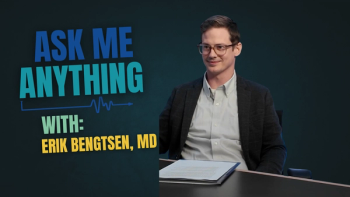
Erik Bengtsen, MD, shares a key depression screening question and explains when oncologists can start a low-dose antidepressant.
Matthew Matasar, MD, outlined his wish list for AI in oncology, and detailed AI-bolstered tools already active across his 14-hospital health system.
This installment of The AI Oncology Revolution discussion with Matthew Matasar, MD, opened with the outline of his current “wish list” for AI in the clinic before walking through what’s already deployed. Matasar was clear about the boundary between the 2: AI scribes and clinical trial matching are modest, real wins today, and the near-term future is AI-enhanced, not AI-replaced. Regarding clinical decision-making, AI isn’t going to sit with a patient and talk through treatment decisions.
Arturo Loaiza-Bonilla, MD, MSEd, FACP, then prompted Matasar to outline AI innovations currently in use at Rutgers, and Matasar detailed the tools actually running across his health system today. He listed retrieval-augmented generation (RAG)-supported tumor boards, AI scribes, and an AI-embedded clinical trial identification pipeline as being used at the institution. Regarding the clinical trial pipeline, Matasar explained it was built to catch eligible patients across 14 hospitals and more than 2 million covered lives in New Jersey.
Loaiza-Bonilla is systemwide chief of hematology and oncology at St. Luke’s University Health Network and co-founder of Massive Bio. Matasar is chief of the Division of Blood Disorders at Rutgers Cancer Institute/Jack & Sheryl Morris Cancer Center and professor of medicine at Rutgers Robert Wood Johnson Medical School, where his clinical and research interests focus on lymphoma.
Loaiza-Bonilla: Looking at the number of patients you’ve treated at your cancer center, what would be your wish list for AI to solve, now and in the future?
Matasar: So right now, what are we doing with AI in the clinic? We use AI scribes. That’s fine; it’s a cute enhancement and saves me a few minutes of time per patient. The notes it generates are actually quite excellent, I’ll admit. Is that a game changer? Obviously not. We’re using it to help identify clinical trial participants and ease the burden of matching patients with trials—work that you’re intimately expert in. We can do better at that, but we’re already dabbling in it, as are many others. I think it’s going to become a very powerful tool in our pockets, alongside our own individual knowledge base, expertise, training, and judgment. I think we’re going to find ourselves, in the near term, turning to AI-enhanced clinical decision-making. AI is not going to replace oncologists; AI is not going to sit with a patient, hold their hand, and talk through the risks and benefits of the approaches available to them. But it’s going to position us, as oncologists, to be better at what we do with our patients.
Loaiza-Bonilla: You had mentioned there were some tools you’re already using at your institution. Can you tell me more about those?
Matasar: The first thing we’re doing is incorporating RAGs inside our tumor boards. The second is AI scribes of limited utility—but we’ll take the win. We’re using models to try to enhance our clinical trial identification pipeline and accrual, where it embeds within our electronic medical record and helps identify patients who could be eligible for trials that might not otherwise be identified by their clinicians. We’re a large health system: 14 hospitals across the state of New Jersey, over 2 million lives covered. There are a lot of doctors in that system who may not have as intimate an awareness of the full clinical trial portfolio and inclusion/exclusion criteria, and having an AI-embedded approach to help those doctors identify clinical trial participants can only help fuel scientific discovery as well as enhance patient outcomes.