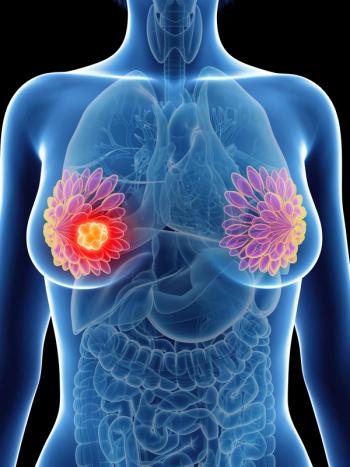
10-year CHN HYPOPMRT data show 3-week postmastectomy RT with nodal irradiation maintains locoregional control without added severe late toxicity.
In the phase 3 evERA trial, interim overall survival data showed a positive trend in favor of giredestrant/everolimus vs endocrine therapy plus everolimus.
The all-oral combination of giredestrant plus everolimus (Afinitor) significantly improved investigator-assessed progression-free survival (PFS) vs standard endocrine therapy plus everolimus in patients with estrogen receptor (ER)–positive, HER2-negative locally advanced or metastatic breast cancer who had progressed after a CDK4/6 inhibitor plus endocrine therapy, according to results from the phase 3 evERA trial (NCT05306340) published in The New England Journal of Medicine.¹
The co-primary end point of investigator-assessed PFS was evaluated first among patients with ESR1-mutated tumors and then in the overall (intention-to-treat) trial population. Among the 207 patients with ESR1-mutated tumors, the median PFS was 10.0 months (95% CI, 8.1-12.9) with giredestrant/everolimus vs 5.5 months (95% CI, 3.8-5.6) with standard therapy/everolimus (HR, 0.38; 95% CI, 0.27-0.54; P <.001). In the overall population, the median PFS was 8.8 months (95% CI, 6.6-9.6) vs 5.5 months (95% CI, 4.0-5.6), respectively (HR, 0.56; 95% CI, 0.44-0.71; P <.001), corresponding to a 44% reduction in the risk of disease progression or death.
The PFS benefit with giredestrant/everolimus appeared consistent across most key subgroups, including among patients with a detectable PIK3CA, AKT1, or PTEN alteration and regardless of the duration of previous CDK4/6 inhibitor therapy, the CDK4/6 inhibitor received, or the choice of standard endocrine therapy in the control group. PFS by blinded independent central review was comparable to investigator-assessed PFS.
“Despite advancements with CDK4/6 inhibitor treatment in the first-line setting, many people with advanced breast cancer will eventually experience disease progression as their tumors become resistant to endocrine therapy,” said lead author Erica L. Mayer, MD, MPH, a medical oncologist at Dana-Farber Cancer Institute, in a news release on the data.2 “The evERA trial demonstrated that the giredestrant combination significantly delayed disease progression, potentially offering a promising all-oral treatment option in a setting where there remains a need for additional treatments to improve patient outcomes.”
Overall survival (OS) data were immature at the time of the interim analysis, but a positive trend favored giredestrant/everolimus. Among patients with ESR1-mutated tumors (59% data maturity), the estimated 18-month OS rate was 71.5% (95% CI, 61.2%-81.7%) with giredestrant/everolimus vs 50.9% (95% CI, 38.4%-63.4%) with standard therapy/everolimus (HR, 0.62; 95% CI, 0.38-1.02). In the overall population (67% data maturity), the estimated 18-month OS rate was 75.1% (95% CI, 68.3%-81.9%) vs 62.0% (95% CI, 54.3%-69.7%), respectively (HR, 0.69; 95% CI, 0.47-1.00). Follow-up for OS is ongoing and will continue to the next analysis.
Adverse events (AEs) occurred in 98.9% of patients who received giredestrant/everolimus and in 96.8% of those who received standard therapy/everolimus. The most common AEs in each arm were stomatitis (47.3% vs 48.9%), diarrhea (26.9% vs 22.6%), and anemia (23.6% vs 21.0%). The investigators reported that AEs were manageable and consistent with the known safety profiles of the individual agents, with no unexpected safety findings, including no photopsia and low rates of bradycardia.
evERA is a phase 3, randomized, open-label, multicenter trial that randomly assigned 373 patients 1:1 to giredestrant plus everolimus or standard endocrine therapy with exemestane, fulvestrant, or tamoxifen plus everolimus, each given orally. Eligible patients had ER-positive, HER2-negative locally advanced or metastatic breast cancer with disease progression or recurrence after a CDK4/6 inhibitor plus endocrine therapy.
ESR1-mutated tumors, which develop in up to 40% of patients with ER-positive disease in the post-CDK4/6 inhibitor setting, were present in 55.5% of the overall population. Giredestrant is an investigational, oral, next-generation selective estrogen receptor degrader and full antagonist.
Based on the evERA data, the FDA accepted a new drug application (NDA) for giredestrant in combination with everolimus for patients with ER-positive, HER2-negative, ESR1-mutated locally advanced or metastatic breast cancer, with a target action date of December 18, 2026. The FDA also accepted, under priority review, an NDA for adjuvant giredestrant in ER-positive, HER2-negative early breast cancer based on the phase 3 lidERA trial (NCT04961996), with a target action date of November 30, 2026.