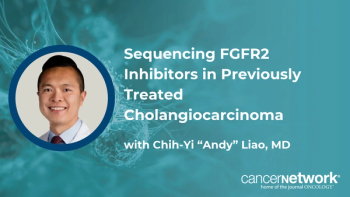
Chih-Yi “Andy” Liao, MD, discusses how oncologists are sequencing pemigatinib, futibatinib, and lirafugratinib and how their tolerability differs.
Edward S. Kim, MD, MBA, explained how City of Hope leverages AI tools to help community oncologists match patients with multidisciplinary clinical trials.
More than 80% of patients with cancer receive care in community-based practices, according to Edward S. Kim, MD, MBA, of City of Hope National Medical Center. Far removed from academic medical hubs where disease-specific specialists typically track trial portfolios, community oncologists managing a broad array of distinct malignancies each day find that keeping pace with relevant protocols across multiple tumor types presents a significant operational hurdle.
In a conversation with CancerNetwork®, Kim explained that effectively expanding research access requires delivering direct operational support and communication to non-academic settings. To bridge the gap between community clinics and academic centers, systems like City of Hope are deploying artificial intelligence (AI). Through internally developed initiatives such as HopeLLM, community providers can automatically cross-reference patient health records against open clinical trials. By automating trial matching, AI tools empower community clinicians to rapidly connect eligible patients with multidisciplinary protocols, ultimately democratizing access to innovative oncology research across diverse health care settings.
Kim is vice physician in chief at City of Hope National Medical Center and system director of clinical trials at City of Hope.
Transcript:
When we work at academic systems—and I have worked at both academic and nonacademic systems—we tend to believe the world revolves around a specialist. I am a specialist in lung cancer, and that is something I value, and I know patients value it. The truth is, more than 80% of our patients are seen in nonacademic, community-based practices. That is where we have to connect our communication, our clinical trials, and our expertise.
With our City of Hope network…we have a heterogeneous mix of embedded community practices and academic campuses. We need to support the physicians and providers in community-based practices who are not surrounded by disease experts and are now being asked to offer clinical trials. In a specialist's clinic, say, a lung cancer specialist, the first 5 patients of the day might all have lung cancer, so it is easy to keep track of the relevant trials. In a community practice, the first patient might have colon cancer, the second breast cancer, the third head and neck cancer, the fourth pancreatic cancer, and the fifth lymphoma. How many trials cover those 5 different cancer types? We are working to make that easier.
One clear area is [AI]…. We are internally building what we call HopeLLM, which has several components. One is clinical trial matching: Whether you are on a campus or at a community site, you can use this program to match our clinical trials against what is in a patient’s records, and that will be a real game changer for our providers who are not on our academic campuses.
City of Hope leads AI-powered health care innovations and launches generative AI tool to save lives and enable nationwide best-in-class cancer care. News release. City of Hope. June 24, 2025. Accessed August 10, 2026. https://tinyurl.com/tesz82wm