
Edward S. Kim, MD, MBA, explained how City of Hope leverages AI tools to help community oncologists match patients with multidisciplinary clinical trials.
Edward S. Kim, MD, MBA, explained how City of Hope leverages AI tools to help community oncologists match patients with multidisciplinary clinical trials.
Additional work is needed on a “significant population that develops lung cancer without a tobacco history,” according to Edward S. Kim, MD, MBA.

In this closing segment, Dr. Alexander Spira and Dr. Edward Kim reflect on key takeaways from the patient case discussions, with a focus on the importance of early and comprehensive biomarker testing in early-stage EGFR-mutated non–small cell lung cancer (NSCLC).
In this segment, Dr. Alexander Spira and Dr. Ticiana Leal discuss how to approach the transition from neoadjuvant therapy to the adjuvant setting in early-stage EGFR-mutated non–small cell lung cancer (NSCLC).
In this segment, Dr. Alexander Spira and Dr. Natalie Vokes explore the impact of neoadjuvant targeted therapy on surgical planning and outcomes in early-stage EGFR-mutated non–small cell lung cancer (NSCLC).
In this segment, Dr. Alexander Spira and Dr. Edward Kim discuss which outcomes are most clinically meaningful when evaluating neoadjuvant targeted therapy in early-stage EGFR-mutated non–small cell lung cancer (NSCLC).
In this segment, Dr. Alexander Spira introduces a second patient case involving a 62-year-old woman with resectable stage IIIA EGFR-mutated non–small cell lung cancer (NSCLC), where the mutation was identified from an initial biopsy.
In this segment, Dr. Alexander Spira and Dr. Edward Kim discuss how to counsel patients who are hesitant to continue adjuvant therapy despite feeling well in early-stage EGFR-mutated non–small cell lung cancer (NSCLC).
In this segment, Dr. Alexander Spira and Dr. Ticiana Leal discuss strategies for monitoring and managing treatment-related adverse events over time in patients receiving adjuvant therapy for early-stage EGFR-mutated non–small cell lung cancer (NSCLC).
In this segment, Dr. Alexander Spira and Dr. Natalie Vokes discuss how to effectively counsel patients on completing the full course of adjuvant therapy in early-stage EGFR-mutated non–small cell lung cancer (NSCLC).
In this segment, Dr. Alexander Spira and Dr. Edward Kim discuss key considerations in selecting patients for adjuvant targeted therapy in early-stage EGFR-mutated non–small cell lung cancer (NSCLC), particularly those with multiple comorbidities.
In this segment, Dr. Alexander Spira introduces the first patient case scenario, focusing on a 72-year-old man with resected stage IIB EGFR-mutated non–small cell lung cancer (NSCLC) who has completed adjuvant chemotherapy and is considering further treatment.
In this segment, Dr. Alexander Spira and Dr. Ticiana Leal discuss variability in treatment selection for early-stage EGFR-mutated non–small cell lung cancer (NSCLC) and strategies to promote guideline-aligned care. Dr. Leal highlights that despite clear recommendations, differences in practice patterns persist, particularly in community settings.
In this segment, Dr. Alexander Spira and Dr. Edward Kim focus on the importance of adverse event management in patients receiving adjuvant EGFR tyrosine kinase inhibitors for early-stage EGFR-mutated non–small cell lung cancer (NSCLC).
In this segment, Dr. Alexander Spira and Dr. Natalie Vokes discuss how to effectively counsel patients starting adjuvant EGFR tyrosine kinase inhibitor therapy in early-stage EGFR-mutated non–small cell lung cancer (NSCLC).
In this segment, Dr. Alexander Spira is joined by Dr. Ticiana Leal, Dr. Edward Kim, and Dr. Natalie Vokes to discuss clinical decision-making around neoadjuvant therapy in early-stage EGFR-mutated non–small cell lung cancer (NSCLC).
In this segment, Dr. Alexander Spira and Dr. Ticiana Leal focus on the importance of multidisciplinary coordination in managing early-stage EGFR-mutated non–small cell lung cancer (NSCLC).
In this segment, Dr. Alexander Spira and Dr. Edward Kim discuss the critical role of early and comprehensive biomarker testing in the management of early-stage EGFR-mutated non–small cell lung cancer (NSCLC).
In this segment, Dr. Alexander Spira and Dr. Natalie Vokes examine how outcomes with adjuvant EGFR tyrosine kinase inhibitors translate from clinical trials into real-world practice in early-stage EGFR-mutated non–small cell lung cancer (NSCLC).
In this segment, Dr. Alexander Spira and Dr. Ticiana Leal discuss how clinicians interpret EGFR tyrosine kinase inhibitor (TKI) data across different clinical trials and apply these findings to early-stage EGFR-mutated non–small cell lung cancer (NSCLC).
In this segment, Dr. Alexander Spira and Dr. Edward Kim discuss how the clinical development of osimertinib across multiple disease stages has influenced treatment expectations in early-stage EGFR-mutated non–small cell lung cancer (NSCLC).
In this segment, Alexander Spira, MD, PhD, engages Natalie Vokes, MD, in a discussion on the distinct biology of EGFR-mutated non–small cell lung cancer and how it informs treatment decisions in the early-stage setting.
NEADORA data highlights why early NGS guides resectable EGFR lung cancer care, favoring perioperative osimertinib and avoiding checkpoint inhibitors.
Experts explain how adjuvant osimertinib changes post-surgery EGFR lung cancer care, from rapid testing to real-world adherence.
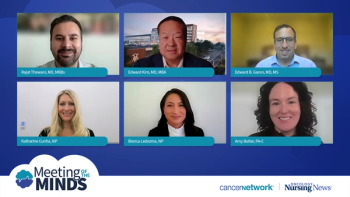
Dr. Kim shares her insights on new investigational therapies for metastatic ALK+ NSCLC that she's particularly excited about.
Dr. Garon discusses the circumstances that might lead him to switch a patient with ALK+ NSCLC from another ALK inhibitor to lorlatinib.
Dr. Kim discusses her approach to selecting the next treatment for patients with ALK+ NSCLC who progress on lorlatinib, including the key factors she considers in making this decision.
Dr. Garon explains his approach to choosing between different ALK inhibitors for ALK+ NSCLC, outlining the factors that guide his selection and when he might prefer alectinib, lorlatinib, or brigatinib.
Dr. Kim discusses her experience with lorlatinib in real-world settings for ALK+ NSCLC, highlighting both the benefits and challenges of incorporating it into clinical practice.
Dr. Garon describes the current treatment landscape for metastatic ALK+ NSCLC and explores alternative treatment options that could have been considered for these patients.
January 30th 2025
December 23rd 2024
January 30th 2025
December 23rd 2024

