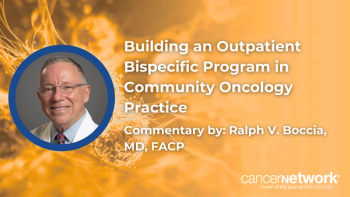
Ralph V. Boccia, MD, FACP, discusses step-up dosing workflows, REMS, staff training, caregivers, and hospital partnerships for bispecifics.
CAR T-cell therapies and bispecific antibodies are still in their infancy, according to Barry Paul, MD.
In a conversation with CancerNetwork®, Barry Paul, MD, discussed highlights and key ideas from the 2026 National Immune Cell Effector Therapy (ICE-T) Conference in Charlotte, North Carolina, especially those related to multiple myeloma management. He broke down critical data shared across sessions dedicated to chimeric antigen receptor (CAR) T-cell therapies and bispecific antibodies, as well as a keynote lecture regarding the future of hematologic oncology practice.
According to Paul, an assistant professor of cancer medicine at Atrium Health Levine Cancer Institute of Wake Forest University School of Medicine, updated findings on agents such as ciltacabtagene autoleucel (cilta-cel; Carvykti) and daratumumab (Darzalex) underscore the importance of introducing investigational cellular therapies into earlier treatment settings. He also said that determining whether fixed-duration therapy with bispecific antibodies can provide similar benefits to indefinite therapy while avoiding potential overtreatment represents another initiative in the field.
Overall, Paul noted that agents such as CAR T-cell therapies and bispecifics are still in their infancy, expressing a hope to further develop these therapeutics and eventually use them in “newer and interesting” ways.
Paul: There was a lot of interesting data that were presented, specifically the data for ciltacabtagene autoleucel. The long-term progression-free survival [PFS] data now show an [approximately] 33% continued PFS rate in patients over 5 years out from their infusion.1 That means that they [needed] no further therapy for over 5 years and remained in a disease-free state, which is excellent. That is encouraging, and we hope to see that continue to be the case. We also hope that by bringing cilta-cel and other CAR T [cells] into earlier lines of therapy, we may continue to see that number of patients who are potentially cured rise. Hopefully, one of the things that is becoming more obvious is that we need to find appropriate biomarkers to determine who these curable patients may be, make sure that those patients get CAR T [cells] as early as possible, and maximize our chance to get a long-term benefit and perhaps even cure.
The daratumumab and teclistamab-cqyv [Tecvayli] data were very encouraging. This was recently presented at the
One of the unmet, unknown areas in this space, though, is with bispecifics. For multiple myeloma, is fixed-duration [therapy] going to provide similar benefit to long-term use? We don’t want to overtreat patients for various reasons. No. 1, it does select for a T-cell–exhausted phenotype. No. 2, it does predispose them to more infectious risks. If there’s a sweet spot where we can treat for perhaps 2 years, then discontinue therapy and still see the long-term benefit, that would be ideal for the bispecifics.
This was exciting. Keith M. Sullivan, MD, FASTCT, was kind enough to share his experience with utilizing cellular therapies and T-cell–redirecting therapies in other disease areas, not just the oncologic space, but specifically in rheumatology. [That includes] some of the autoimmune disorders that have been previously untreatable and incurable. Being able to use things like CAR T, which is a one-time infusion, and see these patients in long-term remission is incredible, and it builds on the experiences that we’ve used in the oncology space to now take them into other areas. I think the sky’s the limit.
We are at a time where we can build on the experiences that we have had and see how we can treat diseases in ways that were previously not even imagined. We, as oncologists, are lucky in the respect that we have a lot of experience utilizing these agents to understand their implementation. Some challenges can be seen with [adverse] effects, and some unique issues are inherent to utilizing these agents. Now, it’s incumbent upon us to utilize that knowledge to help drive research and exploration in other areas where these agents have the potential to be game changers.
What you’re seeing is that the field is just taking off. We spoke a bit about how it’s taking off in other disease areas, as opposed to just the oncologic spaces. Having these meetings relatively regularly allows us to stay on top of the most recent updates and the most important data, both in oncology and other areas, as well. My hope is that the Orlando meeting will just build upon some of the [framework] that we set in the Charlotte meeting to further delineate how we can best utilize these agents, how they can be utilized in other areas, and what new targets are out there.
We are only as good as the targets that we can find. We need targets that are specific to the cells that are causing the problem without overtreating normal cells as well because that’s where toxicities and [adverse] effects tend to manifest. It’s incumbent upon us to find new targets and find ways to target them in less toxic and more effective ways. The more data that come out, the more meetings we need to make sure that we’re keeping on top of this and standardizing our practices across the country and world.
The big unmet question [or] unmet medical need right now is the sequencing question. I want to know if there is a patient population who is potentially curable, and if so, [we must] make sure that we don’t miss that opportunity when that window is open. Being able to utilize T-cell–redirecting therapies in patients who are less heavily pretreated will likely allow us to utilize more healthy T cells and likely capitalize on a more beneficial space because these patients’ T cells are more [stimulable].
Finding patients who have this curable phenotype or genotype––it may be something genetic––is incumbent because we need to make sure that we are not missing [them]. Similarly, if these patients are not potentially curable but they can respond beautifully long term to other agents or even to CAR [T cells] at some point, [we must] make sure that we’re not overtreating these other patients and making sure that we’re providing them the safest and most effective care, understanding that even if they’re not curable, we can still achieve a functional cure, meaning that they live to a normal life expectancy. Even though their myeloma may not be cured, it doesn’t affect their life expectancy.
One of the themes of the Charlotte meeting was that CAR T cells are still in their infancy. Bispecifics are still in their infancy. We had an excellent session on utilizing these in solid cancers, which is starting to happen, but it’s significantly less mature than the key malignancy data are. The leukemia data are newer than the lymphoma and myeloma data. You can see that things are just starting to build. It’s impressive that we are in our early phases here, but we will continue to build the field.
The focus of this meeting was on making sure that everyone understands that and utilizing our experience to help build upon the technologies and the experiences that we have to further develop these agents and utilize them in newer and interesting ways. My hope is that, 3 or 4 years from now, we’re seeing these [therapies] used in new indications and seeing patients benefit from that––getting safe and effective therapy that wasn’t even thought of 5 years ago.