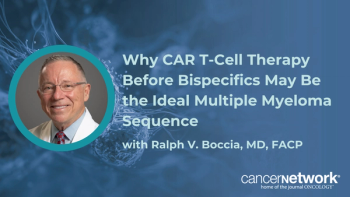
Ralph V. Boccia, MD, FACP, explained why CAR T-cell therapy followed by bispecific antibodies may be the preferred sequence at first relapse in multiple myeloma.
Matteo S. Carlino, MD, PhD, FRACP, explains how the individualized neoantigen therapy V940 is designed and delivered in melanoma.
Matteo S. Carlino, MD, PhD, FRACP, a medical oncologist at Westmead and Blacktown Hospitals, a faculty member at Melanoma Institute Australia, and a clinical senior lecturer at The University of Sydney in Australia, discussed the mechanism of action behind
Unlike a standard off-the-shelf drug, V940 is manufactured uniquely for each patient. Tumor tissue is sequenced, the patient’s HLA type is determined to characterize their immune system, and bioinformatics tools are then used to identify up to 34 neoantigens specific to that individual’s cancer. The resulting product is delivered as an intramuscular injection, prompting antigen presentation intended to generate an immune response directed at those tumor-specific antigens.
Carlino explained why this individualized design has led some to describe the therapy as a personalized cancer vaccine and he walked through the steps from tumor sequencing to the creation of a patient-specific injectable product, distinguishing V940’s manufacturing process from that of conventional, flat-dosed immunotherapies used in melanoma. He also outlined how this individualized design carries downstream implications for how V940 will ultimately be handled in clinical practice.
Transcript:
CancerNetwork: Are you able to briefly explain the mechanism of action of V940?
Carlino: V940 is a personalized mRNA-based individualized neoantigen therapy. Some people refer to it as a personalized vaccine. Essentially, individual patients have their tumor sequenced and are HLA-typed to characterize their immune system. Bioinformatics is then used to design a product with up to 34 neoantigens individualized to that patient. That product is injected intramuscularly, leading to antigen presentation of these 34 neoantigens, with the hope of getting an immune response directed toward antigens specific to the tumor.
Merck and Moderna announce phase 3 INTerpath-001 trial of intismeran autogene plus KEYTRUDA® met endpoints of recurrence-free survival (RFS) and distant metastasis-free survival (DMFS) in patients with completely resected stage IIB-IV melanoma. News release. Merck. August 19, 2026. Accessed August 25, 2026. https://tinyurl.com/yxe3d24n