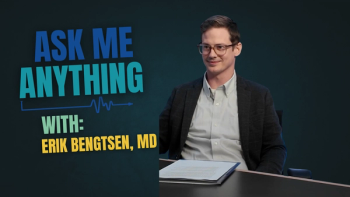
Erik Bengtsen, MD, shares a key depression screening question and explains when oncologists can start a low-dose antidepressant.
Matthew Matasar, MD, explained why AI-assisted digital pathology may meaningfully improve diagnostic precision in hematologic malignancies.
Arturo Loaiza-Bonilla, MD, MSEd, FACP, continued his AI Oncology Revolution discussion with Matthew Matasar, MD, by raising a still-speculative application of AI in oncology, using retinal imaging to flag hematologic malignancy risk based on blood vessel characteristics, before turning to a nearer-term technology: AI-assisted digital pathology. Matasar, of Rutgers Cancer Institute, argued that digital pathology sits squarely in the “here and now” for hematologic malignancy, where diagnostic precision is both critical to outcomes and notoriously heterogeneous. Matasar cited data showing that expert hematopathology second-opinion review changes guideline-directed management in roughly 1 of every 5 cases compared with community-based review, a gap he said makes AI-based pathology support not just promising, but necessary.
The conversation then turned to a structural problem behind AI’s growing footprint in oncology broadly: every institution is currently building its own governance approach in isolation. Matasar argued that organizations such as the American Society for Clinical Oncology (ASCO), the American Society of Hematology (ASH), or the American Medical Association (AMA) are well positioned to help define shared priorities and tolerances for AI use across health systems, rather than leaving each center to develop parallel, non-interoperable frameworks.
Loaiza-Bonilla is systemwide chief of hematology and oncology at St. Luke’s University Health Network and co-founder of Massive Bio. Matasar is chief of the Division of Blood Disorders at Rutgers Cancer Institute/Jack & Sheryl Morris Cancer Center and professor of medicine at Rutgers Robert Wood Johnson Medical School, where his clinical and research interests focus on lymphoma, and editorial advisory board member for the journal ONCOLOGY®.
Loaiza-Bonilla: There are some interesting models we spoke briefly about before this, for example, someone looking at a retinal exam and, based on the size of the blood vessels, predicting the potential appearance of a hematological malignancy. That, to me, is like science fiction.
Matasar: It does feel like science fiction.
Loaiza-Bonilla: There are other, more contemporary approaches, like digital pathology making diagnoses based on imaging. Have you seen some of those efforts — presented at ASH, for example, or elsewhere — and is digital pathology something you feel is going to be part of our workflows in the future?
Matasar: We’ve talked about the here-and-now, the near future, and the distant future. Digital pathology is the here-and-now, slash near future, especially in my world of hematologic malignancy, where we know that diagnostic precision is both critical to outcomes and also extremely heterogeneous. Even just looking back at comparisons of expert hematopathology opinions vs community-based hematopathology opinions: expert second-opinion review alters a diagnosis, in a way that changes guideline-based management, 1 in 5 times.
Loaiza-Bonilla: Wow.
Matasar: That’s just comparing an expert with an individual brain vs a general pathologist with an individual brain. There’s no way that incorporating AI-based approaches to pathology isn’t going to further enhance our diagnostic accuracy and precision, and we know that’s going to lead to better outcomes. This isn’t only obvious; it’s critically needed.
Loaiza-Bonilla: Yeah, and I just see that the implementation is so scattered around, right? I think there has to be some form of a commons, where people come together and say, let’s set up frameworks for how we’re going to implement this more robustly across different health systems, because everyone’s doing their own thing.
Matasar: Yes. You see Mayo Clinic doing something, [Memorial Sloan Kettering] doing something else, Rutgers has our own AI governance, but I feel we need to have a much closer relationship to really make this more generalizable and robust. This is where our societies can weigh in effectively, whether it’s ASCO, ASH, or even the AMA. We can lean on our collective voice to help define what our priorities are, what our tolerances are, and try to define what we see as the good, and how we get there.