

News|Videos|July 27, 2026
Managing GI Adverse Effects to Keep Patients on Oral AML Therapy
Author(s)Courtney DiNardo, MD, MSCE, Michael Savona, MD
Courtney D. DiNardo, MD, MSCE, and Michael R. Savona, MD, shared antiemetic strategies for GI AEs with oral AML regimens.
Advertisement
Episodes in this series




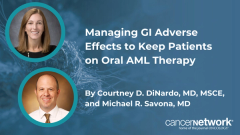
Because the all-oral regimen of decitabine/cedazuridine (DEC-C; Inqovi) plus venetoclax (Venclexta) pairs an oral hypomethylating HMA backbone with venetoclax, gastrointestinal adverse events (AEs) can directly threaten adherence. CancerNetwork® spoke with Courtney D. DiNardo, MD, MSCE, professor in the Department of Leukemia and Division of Cancer Medicine at The University of Texas MD Anderson Cancer Center in Houston; and Michael R. Savona, MD, professor of internal medicine and cancer biology and director of the Hematologic Malignancies Research and Early Therapy Program at Vanderbilt University Medical Center, about the specific supportive care and antiemetic strategies they use to help patients stay on their prescribed doses.
Transcript:
CancerNetwork: Because this is an oral backbone paired with venetoclax, gastrointestinal AEs can directly threaten compliance. What specific supportive care and antiemetic strategies do you recommend to ensure patients do not miss doses?
DiNardo: There are GI-related AEs with most oral, absorbable therapies; I do not find that this is particularly more [common] than with others. We typically have patients take an antiemetic prior to dosing, often ondansetron [Zofran], and then we adjust as needed. Some patients may have more loose stools, some constipation, some nausea, or occasional vomiting. There is a lot of good supportive care that we can add as appropriate if needed. Oftentimes, it is just ondansetron as a pre-dose, and then modifications as needed.
Savona: I completely agree with Courtney. It is one of those things where you do not know if someone is going to get constipation or diarrhea; sometimes, [it is] nothing at all. I would say a low dose of [ondansetron] prior to dosing days is usually enough. There is the uncommon patient who will need [as-needed] dosing throughout the dosing period, but that tends to cause more problems related to the antiemetic than it does in preventing nausea. I do not see that as a big problem.
Advertisement
Related Content




!["I can’t make [treatment] decisions for you, but I can give you realistic expectations," said Herbert Lepor, MD, of NYU Langone Health.](https://cdn.sanity.io/images/0vv8moc6/cancernetwork/11e93c561a9ff98f731b152d7f48e6f792831864-1000x1000.jpg?w=350&fit=crop&auto=format)

















































Advertisement
Advertisement
Trending on CancerNetwork
1
FDA Accepts NDA for Daraxonrasib in Pretreated Metastatic Pancreatic Cancer
2
CAR T-Cell Expansion Predicts Toxicity, But Not Always Efficacy
3
Mapping the Full CAR T-Cell Journey in DLBCL From Referral to Survivorship
4
Real-World ARC Data Reassure Venetoclax Dose Flexibility in AML
5