
News|Videos|July 26, 2026
Real-World ARC Data Reassure Venetoclax Dose Flexibility in AML
Author(s)Courtney DiNardo, MD, MSCE, Michael Savona, MD
Michael R. Savona, MD, and Courtney D. DiNardo, MD, MSCE, discussed ARC initiative data on venetoclax dose modifications in AML.
Advertisement
Episodes in this series
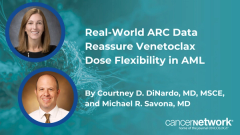
Real-world data from the AML Real-World EvidenCe (ARC) initiative showed that frequent venetoclax (Venclexta) dose modifications and drug interactions did not compromise response durability in patients with newly diagnosed acute myeloid leukemia (AML).1 CancerNetwork® spoke with Michael R. Savona, MD, professor of internal medicine and cancer biology and director of the Hematologic Malignancies Research and Early Therapy Program at Vanderbilt University Medical Center; and Courtney D. DiNardo, MD, MSCE, professor in the Department of Leukemia and Division of Cancer Medicine at The University of Texas MD Anderson Cancer Center, about how reassuring this is for community clinicians who worry about deviating from a strict clinical trial schedule when using oral decitabine/cedazuridine (DEC-C; Inqovi) plus venetoclax.
Transcript:
CancerNetwork: Real-world data from the ARC initiative showed that frequent venetoclax dose modifications and drug interactions do not compromise response durability. How reassuring is this for community clinicians who worry about deviating from a strict clinical trial schedule?
Savona: This is something we knew, but it is nice to formally demonstrate this idea, and it is important messaging for [patients] in the community to understand. We got a little distracted with the US prescribing information (USPI) and clinical trials. The insistence on following the USPI has led people to think you have to give 400 mg and stay on for 28 days, and that is just not how it works. It would be foolhardy to do that with some patients. It is important for people to get the message that none of this is written in stone. We try to get the drug into people, but we do not want to overdo it.
DiNardo: I will just add that we tried to create a clear story in the New England Journal of Medicine manuscript that came along with the ASCERTAIN-V [NCT04657081] data, showing how, as we went from phase 1 to phase 2a to phase 2b, we were allowed to make modifications as was right for the patient and clinically appropriate, and we were not as prescriptive about following specific guidelines.2 Patients did better; they potentially recovered faster, they stayed on study longer, and they had more durable responses. It provided a lot of reassurance that dosing the patient the right way for that patient is the right thing to do.
References
- Wolach O, Chen EC, Zeidner JF, et al. Real-world patient management practices in responders to venetoclax for newly diagnosed acute myeloid leukemia. J Clin Oncol. 2025;43(suppl 16):6527. doi:10.1200/JCO.2025.43.16_suppl.6527
- Roboz GJ, Zeidan AM, Mannis GN, et al. All-oral treatment of newly diagnosed acute myeloid leukemia. N Engl J Med. 2026;394(21):2107-2116. doi:10.1056/NEJMoa2510223
Advertisement
Related Content
Advertisement
!["I can’t make [treatment] decisions for you, but I can give you realistic expectations," said Herbert Lepor, MD, of NYU Langone Health.](https://cdn.sanity.io/images/0vv8moc6/cancernetwork/11e93c561a9ff98f731b152d7f48e6f792831864-1000x1000.jpg?w=350&fit=crop&auto=format)





















































Advertisement
Advertisement
Trending on CancerNetwork
1
FDA Accepts NDA for Daraxonrasib in Pretreated Metastatic Pancreatic Cancer
2
Mapping the Full CAR T-Cell Journey in DLBCL From Referral to Survivorship
3
RASolute 302 and the Future of Pancreatic Cancer Treatment: Paul Oberstein, MD, on the KRAS Breakthrough
4
Balancing Oncologic Outcomes With Patient Priorities in Prostate Cancer Care
5