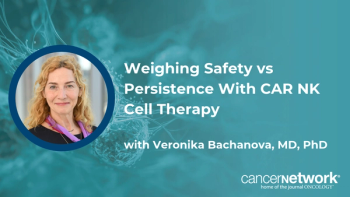
Veronika Bachanova, MD, PhD, discussed how the favorable safety profile of CAR natural killer cell therapies may come with trade-offs in persistence and response durability.
Orca-T is a “big advance” that must be studied further among patients with acute leukemias and myelodysplastic syndromes.
The phase 3 Precision-T trial (NCT05316701) supported the
Wendy Stock, MD, spoke with CancerNetwork® about the key takeaways from these data and what remains to be studied. She is the Anjuli Seth Nayak Professor of Medicine, cochair of the Leukemia Committee for the National Cancer Institute–supported Alliance for Clinical Trials in Oncology, and coleader of the Clinical and Experimental Therapeutics Research Program at the University of Chicago Medicine Comprehensive Cancer Center.
Transcript:
CancerNetwork: What do you hope others take away from this conversation, as well as the approval overall?
Stock: I think the most important point is that the primary end point was achieved, which was very statistically significant GVHD-free survival in patients who received Orca-T—the regulatory T cells infused. There were hints of other potentially good outcomes as well from this trial: fewer infections, quicker time to engraftment, and potentially even less acute GVHD. But that all needs to be followed up on in subsequent studies with longer follow-up because perhaps relapse-free survival and overall survival will also be better. That has not yet been shown, but perhaps it will be.
I think the big takeaway is that over the last 10 years, we have incredibly exciting, still-to-be-tweaked methods for improving outcomes for patients undergoing transplant, which is such an important procedure for curing or [achieving] long-term survival for patients with acute leukemias and high-risk myelodysplastic syndromes. This is a big advance, and it needs to be studied further, including comparisons with other major improvements in the world of transplant, such as post-transplant cyclophosphamide.
Of course, I do not know what the cost of this product is, but it is going to be expensive; it will increase costs, and that is another question that can be answered in a prospective trial comparing [Orca-T vs post-transplant cyclophosphamide] in a similar population.