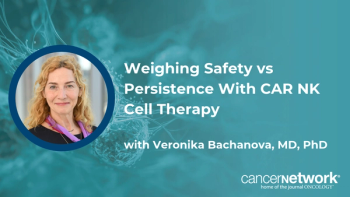
Veronika Bachanova, MD, PhD, discussed how the favorable safety profile of CAR natural killer cell therapies may come with trade-offs in persistence and response durability.
Whether Orca-T competes with post-transplant cyclophosphamide for GVHD prevention must be studied prospectively, said Wendy Stock, MD.
Allogeneic regulatory T cell–containing immunotherapy with hematopoietic stem and progenitor cell (HSPC) and T cells-vldq (Tregzi; Orca-T)
Stock is the Anjuli Seth Nayak Professor of Medicine, cochair of the Leukemia Committee for the National Cancer Institute–supported Alliance for Clinical Trials in Oncology, and coleader of the Clinical and Experimental Therapeutics Research Program at the University of Chicago Medicine Comprehensive Cancer Center.
Transcript:
CancerNetwork: The standard of care for GVHD prophylaxis has shifted heavily toward PTCy in recent years. How do you position Orca-T against a PTCy backbone?
Stock: It is a totally different concept in the sense that…post-transplant cyclophosphamide is not graft engineering per se, in terms of ex vivo engineering. Yes, I think it could be a competitor to Orca-T. I think that is not known, and that is one of the key questions that needs to be answered prospectively in terms of whether or not these 2 approaches are comparable, or whether one is better than the other.
Orca-T was tested in a different population—a very specific population. These were all HLA [human leukocyte antigen]-matched recipient and donor pairs, and it was done in the myeloablative setting. The Orca-T study does not include mismatched donors and does not include reduced-intensity conditioning. It is a very specific subset that has been shown in a randomized trial to be more effective than not manipulating the graft, but it was not compared with PTCy. That is a huge question in many ways, including potentially toxicity, which we do not fully know about. We do know there are differences in toxicity with PTCy vs non-PTCy approaches, but what we do not know is the improvement in GVHD-free survival when these 2 approaches are compared head-to-head in a similar population of patients.