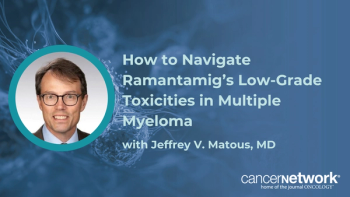
Jeffrey V. Matous, MD, discusses how to counsel patients on chronic, low-grade toxicities to support adherence to ramantamig.
Data from the phase 3 Precision-T trial show improvements in overall survival and relapse-free survival with the use of Orca-T.
In October 2025, the
CancerNetwork® spoke with Gwen Nichols, MD, executive vice president and chief medical officer at Blood Cancer United, about what the potential FDA approval of Orca-T may represent for patients with different blood cancers. As part of the discussion, she highlighted key efficacy findings from the Precision-T trial, which demonstrated “reassuring” outcomes regarding end points like relapse-free survival and graft-versus-host disease (GVHD).
Updated results presented at the
Transcript:
You want to look at the end point of GVHD, which was less moderate to severe in the Orca-T group. Also, survival seemed to be favored [with Orca-T], and relapse-free survival [also] was favored. The relapse-free survival is an incredibly important point because you don't want to go through the rigors, the cost—and [when] I mean cost, not just dollars cost, but the personal cost of a transplant—only to have the disease come back. If there was evidence that decreasing the chance of graft-versus-host disease increased your chance of relapse, that would be a real negative, and [investigators would] have to do more studies. But that didn't seem to be the case.
That, for me, was reassuring because that was my first question. What we understand is that the immune system helps eliminate leukemia cells, but it can also cause GHVD. It's an intricate balance of many different immune factors... If you use this immune therapy, does it do something to stop the immune effect of the graft against the leukemia, a graft-versus-leukemia effect? It does seem to [stop], at least in this one well-conducted study. It's going to need to continue to be followed, but that was reassuring for the use of this therapy.