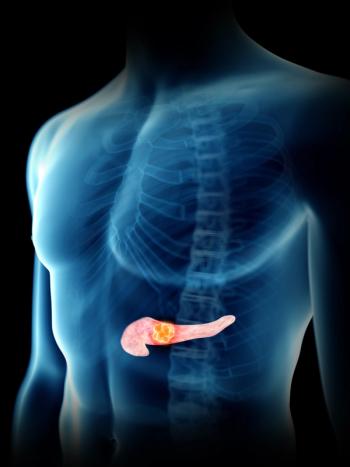
The oral KRAS G12D inhibitor VS-7375 produced responses in pancreatic, colorectal, and lung cancers in the phase 1/2 TARGET-D 101 trial.
Data from the phase 3 OptiTROP-Lung06 trial also showed a positive trend in overall survival with sac-TMT plus pembrolizumab in patients with NSCLC.
Sacituzumab tirumotecan (sac-TMT; SKB264/MK-2870) plus pembrolizumab (Keytruda) significantly improved progression-free survival (PFS) compared with chemotherapy plus pembrolizumab as first-line treatment for patients with PD-L1–negative locally advanced or metastatic nonsquamous non–small cell lung cancer (NSCLC), meeting the primary end point of the phase 3 OptiTROP-Lung06 trial at a prespecified interim analysis, according to a news release from Kelun-Biotech.¹
At a prespecified interim analysis, sac-TMT plus pembrolizumab demonstrated a statistically significant and clinically meaningful improvement in PFS as assessed by blinded independent central review (BICR) compared with pembrolizumab plus pemetrexed and platinum-based chemotherapy. A positive trend in overall survival (OS) was also observed with the sac-TMT combo.
The safety profile of the combination appeared consistent with previously reported studies, with no new safety signals identified. According to the developers, this is the first phase 3 study of an antibody-drug conjugate (ADC) combined with an immune checkpoint inhibitor to meet its primary end point in the first-line treatment of driver gene–negative and PD-L1–negative nonsquamous NSCLC.
“For patients with driver gene‑negative and PD‑L1‑negative NSCLC, immunotherapy combined with chemotherapy remains the current standard first-line treatment and has improved patient outcomes to some extent. However, long-term survival benefit remains limited. The achievement of positive results in the phase 3 OptiTROP-Lung06 study represents an important breakthrough in the first-line treatment of PD-L1–negative NSCLC,” said national lead principal investigator Caicun Zhou, MD, PhD, professor at Shanghai East Hospital, Tongji University, in the press release.1 “These results not only provide robust clinical evidence supporting the ‘ADC plus immunotherapy’ strategy of sac-TMT in combination with pembrolizumab, but also have the potential to offer these patients a new first-line treatment option beyond the current standard of care, with the promise of improved survival outcomes.”
OptiTROP-Lung06 is a randomized, open-label, multicenter phase 3 study evaluating sac-TMT plus pembrolizumab vs chemotherapy plus pembrolizumab as first-line treatment for patients with locally advanced or metastatic non–squamous NSCLC who have a PD-L1 tumor proportion score of less than 1%. The primary end point is PFS by BICR assessment; secondary end points include OS and safety. The comparator arm consisted of pembrolizumab plus pemetrexed and platinum-based chemotherapy, the current first-line standard of care in this setting.
The company plans to communicate these results with the Center for Drug Evaluation of China’s National Medical Products Administration.
Sac-TMT is a TROP2-directed ADC composed of a humanized anti-TROP2 monoclonal antibody that harnesses a bifunctional linker to a belotecan-derivative topoisomerase I inhibitor payload, with a drug-to-antibody ratio of 7.4. With its KL610023 payload, the drug can create a bystander effect on adjacent tumor cells.
Sac-TMT plus pembrolizumab previously met the primary end point of the
“The positive results of both the OptiTROP-Lung05 and OptiTROP-Lung06 studies confirm the strong synergetic effect of sac-TMT combined with pembrolizumab, supporting the potential of this combination regimen to benefit the broad first-line NSCLC population and bringing new treatment opportunities to patients with different PD-L1 expression levels,” Michael Ge, chief executive officer at Kelun-Biotech, concluded.1