Parul N. Barry, MD, FACRO, discussed extending advanced radiation services to satellite sites and offered guidance for early career physicians building new programs.
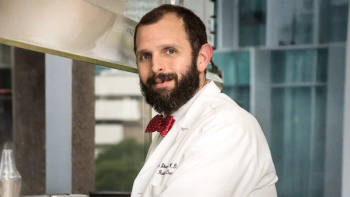
Tyler J. Wilhite, MD, discussed scaling low-dose radiation therapy for osteoarthritis from 1 patient to nearly 20 centers and the referral work behind it.
The faculty at the University of Pittsburgh Medical Center (UPMC) organized the
In an interview with CancerNetwork® at the symposium, Tyler J. Wilhite, MD, discussed the talk he gave on low-dose radiation therapy for benign conditions, why UPMC brought the service into its radiation oncology network, and how the referral relationships with rheumatology, orthopedic surgery, and primary care came together. He described what he tells a smaller center hesitant to start, and the operational adjustments that treating patients without cancer required, down to rewriting the folder handed to every patient.
Wilhite closed by discussing what UPMC set out to offer attendees that a large research meeting does not, how the department scales a new service across most of Pennsylvania and into surrounding states, and the advice he considers most valuable in building a service line.
Wilhite is the regional vice chair of radiation oncology at UPMC Hillman Cancer Center and practices in the Department of Radiation Oncology at the University of Pittsburgh, based at the Mary Hillman Jennings Radiation Oncology Center at UPMC Shadyside.
CancerNetwork: What was the subject of your presentation?
Wilhite: Today I gave a talk about low-dose radiation therapy for benign conditions, and in particular, I focused on osteoarthritis. It's an old technique. It's been used for over 100 years. But in the United States, it's really only been the past 3 or 4 years that radiation oncologists have been doing this. We treated our first patient with osteoarthritis in December of 2023, and since that time, across UPMC, we've treated over 1000 patients.
Why did UPMC decide to bring low-dose radiation for benign conditions into the fold?
Number one, it's helpful for patients. There was an awareness that this is something that works. It's effective. If you look at the data, there are publications that include [thousands] of patients that show that about 80% have pain relief from the treatment, and even more recently, there is some randomized clinical trial data that shows statistically significant benefits. So now there's even more evidence in favor of offering this to patients than there was when we started.
This brings radiation oncologists into contact with specialists who aren't usually in their referral process, like orthopedics and rheumatology. How crucial is it to involve them, and how do you build those relationships?
At first, we reached out to different physicians in our community and explained how the radiation works. [We] showed them some of the data. There's a variety of specialists who typically see these patients. What I've also found is that many of these patients are managed even just in primary care, and often the primary care physicians are grateful that perhaps there's another treatment option available for these patients.
The low-dose radiation is noninvasive. There are basically no adverse effects—I've yet to see an adverse effect from this treatment, and in looking at some of the clinical trials that have been done, they actually have 0% adverse effects. It's a very nice option.
Rheumatology, orthopedic surgery, all those fields have patients who are, for example, elderly or maybe medically not suitable for other treatments. You might have a patient on blood thinners, where even being on nonsteroidal anti-inflammatory drugs might not be the best thing. The low-dose radiation really fits nicely in the paradigm with all the other options available for arthritis treatment. It really doesn't take away from anything or compete with anything. It just took a little bit of reaching out, building the relationships. But altogether, I'd say it's synergistic with everything else, so there's really not much difficulty in highlighting that to people.
What would you tell a regional or smaller center that is considering implementing this but is hesitant?
The good news is the technology and the techniques are very similar to what we otherwise do, and so the bar to entry is pretty low. It really takes some encouragement at times because some of the physicians just haven't done it before. But once they realize that it's actually much easier than many of the other treatments they're used to doing, and once the staff learns and understands that this is a little bit easier, these patients tend to, in many cases, be less sick than the patients we're otherwise caring for. Altogether, it's a nice thing to be able to do to help people in a different way. For these smaller centers, they realize that it's not so hard once they try.
This is a different population of patients than radiation oncologists typically treat. What differences do you have to account for in caring for them?
That's true…. So much of our patient experience is designed around the cancer experience. We were mindful of that, and we changed some of the documents. We have a pamphlet or a folder we give to all the patients. We went through and made sure that we had one that was more appropriate for the patients with arthritis. We don't want to scare them and give them all this extra information that's not relevant to them and that they don't need.
Additionally, our staff appreciates knowing that there are different types of patients walking around, so they don't just make an assumption about a patient's condition or what they might need. Now it's more normal that we understand that we're taking care of more than just [patients with cancer], so it's a little bit more diverse in the waiting room and the problems that people have. From a patient perspective too, it's a little bit of a different conversation with them in terms of what to expect.
This conference is smaller than the American Society of Clinical Oncology (ASCO) Annual Meeting or the European Society for Medical Oncology (ESMO) Congress, but that doesn’t make it less valuable. What different goals should attendees have coming here, and what will they find that they wouldn’t at one of those?
When we were thinking about designing this conference and trying to think about what UPMC could bring to the table, we were trying to think about what the value add was. Why would somebody want to take a couple days and come spend time with us? One thing we do very well is work collaboratively in terms of the clinicians, the physicians, but also the business administration and the staff.
The arthritis [program] is a great example. A lot of places are doing this, but with the way that we build programs and the way that we get things done, we are able to scale very quickly. Our department stretches across the majority of the state of Pennsylvania, but even extends into some of our surrounding states as well…. I treated the first patient at UPMC Shadyside, which is our main site, in December 2023. But since then, we've treated patients at probably nearly 20 centers at this point, and treated over [a thousand] patients with arthritis in the last few years.
That's where we think a little differently. We learn a lot in a short time frame about what the challenges are, or what the different barriers can be, especially with all the different teams and people. Some of our sites have different complements of staff or different complements of machines. We learn a lot of lessons in terms of implementation in the program. It also includes other programs like brachytherapy and brain radiosurgery, programs that we think are very important and that take a little bit of extra energy and focus to really get right. That's what we're trying to highlight today: in addition to the clinical value, also the nuts and bolts of how to get these things off the ground, how to grow them successfully, how to build those relationships, and how to make it work.