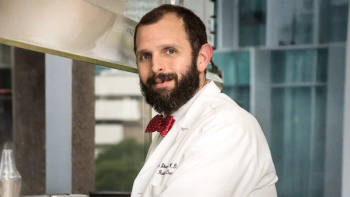
Parul N. Barry, MD, FACRO, discussed extending advanced radiation services to satellite sites and offered guidance for early career physicians building new programs.
Rocbrutinib plus R-CHOP yielded a 100% ORR and an 86.7% CR rate in 15 patients with untreated non-GCB DLBCL, warranting randomized evaluation.
Although R-CHOP (rituximab [Rituxan], cyclophosphamide, doxorubicin, vincristine, and prednisone) has long served as the frontline backbone for diffuse large B-cell lymphoma (DLBCL), a subset of patients, particularly those with non–germinal center B-cell–like (non-GCB) disease, are refractory to or relapse after treatment, and prior efforts to add Bruton tyrosine kinase (BTK) inhibitors to the regimen have yielded mixed results.
At the
Cai began by outlining rocbrutinib's dual covalent and noncovalent binding mechanism and why it warranted revisiting BTK inhibition after the phase 3 PHOENIX trial (NCT01855750). She then discussed the biologic rationale for combining a BTK inhibitor with R-CHOP and for moving the combination into the frontline setting. Cai also reviewed early efficacy and safety findings, placed them in the context of the
Cai: We investigated rocbrutinib plus R-CHOP in previously untreated B-cell lymphoma, with a focus on non-GCB DLBCL. Rocbrutinib, also called LP-168, is an oral BTK inhibitor, and what distinguishes it is its dual binding mechanism. Studies have shown covalent binding to wild-type BTK and noncovalent binding to C481-mutated BTK. It is also highly selective for BTK, which provides a rationale for limiting off-target effects. These features, together with the encouraging monotherapy efficacy seen in an early-phase study of rocbrutinib in non-GCB DLBCL after at least 2 prior lines of therapy, make it a candidate worth exploring in treatment-naive DLBCL.
We understand that the PHOENIX experience is important here. Ibrutinib [Imbruvica] plus R-CHOP did not meet the trial's primary end point, and toxicity compromised chemotherapy delivery in older patients.2 Other similar studies include [the phase 3 ESCALADE trial (NCT04529772)] with acalabrutinib [Calquence] and the [phase 3 BELIEVE-01 trial (NCT05234684)] with orelabrutinib, which focused on the MCD genetic subtype. With rocbrutinib, the unique dual binding property, selectivity, favorable pharmacokinetic/pharmacodynamic [PK/PD] profile, and early monotherapy clinical activity gave us a reason to revisit this strategy. Together, this study should help clarify both drug choice and patient selection.
BTK inhibitors target a survival pathway that may remain active despite R-CHOP. Some B-cell tumors, particularly those of the activated B-cell [ABC] subtype, depend on B-cell receptor signaling. BTK is part of that pathway and is therefore a possible target for a combination regimen. As I mentioned earlier, BTK inhibitors in combination with R-CHOP have been tested or are currently being evaluated in DLBCL, especially ABC or non-GCB DLBCL.
Rocbrutinib, as a fourth-generation oral BTK inhibitor, produced an overall response rate [ORR] of 72.2% and a complete remission rate of 44.4% at a dose of 200 mg daily or higher in relapsed/refractory non-GCB DLBCL, compared with the historical response rate of roughly 20% to 40% for earlier covalent BTK inhibitors.3 That supports further evaluation in combination with R-CHOP.
Our aim in newly diagnosed DLBCL is cure. R-CHOP can cure many patients, but some are refractory or relapse after treatment. If we can deepen the initial response by targeting a pathway the lymphoma depends on, we may be able to reduce the risk of relapse. That is the rationale for studying the combination up front.
The early responses were encouraging. Among the 15 patients who received at least 4 cycles of combination treatment, the ORR reached 100%, and 13 achieved a complete remission, which gives a complete response [CR] rate of 86.7%. Responses were rapid. The median time to response was 1.25 months, and the median time to CR was 2.69 months. In the circulating tumor DNA [ctDNA] analysis after CR, 7 patients were minimal residual disease [MRD] negative, and 1 result was not available.1
[The frontMIND trial] provides randomized phase 3 evidence that adding tafasitamab-cxix [Monjuvi] and lenalidomide [Revlimid] to R-CHOP can improve progression-free survival.4 Our research provides an early signal in non-GCB disease with an oral fourth-generation BTK inhibitor. The next question is whether this response lasts and translates into a benefit in a controlled trial.
As of the data cutoff, we saw no dose-limiting toxicities, atrial fibrillation or flutter, major bleeding, or treatment-related deaths. Cytopenias and infections still require close management. A larger study with longer follow-up is needed to understand uncommon risks.
For this combination, I would want longer follow-up and a randomized trial that can test durable benefit and safety against a frontline standard.
[Approval] is a possibility because a pivotal randomized phase 2 trial (NCT07189065) in relapsed/refractory non-GCB DLBCL comparing rocbrutinib monotherapy with investigator's choice of [bendamustine and rituximab (BR)] or [lenalidomide and rituximab (R2)] is ongoing in China.5 However, it is too early to predict approval in DLBCL or whether rocbrutinib would be the first. I am encouraged by the activity, but the clinical evidence and regulatory review will determine whether it becomes a treatment option.