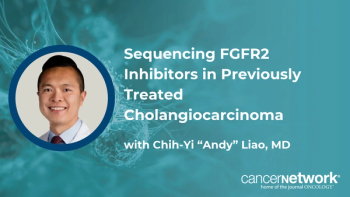
Chih-Yi “Andy” Liao, MD, discusses how oncologists are sequencing pemigatinib, futibatinib, and lirafugratinib and how their tolerability differs.
Nicholas Hornstein, MD, PhD, ranks RASolute 302, BREAKWATER, MATTERHORN, and more in a real-time discussion on Double Blind.
CancerNetwork® spoke with Nicholas Hornstein, MD, PhD, a gastrointestinal oncologist at Northwell Health and a 2024 American Society of Clinical Oncology (ASCO) Young Investigator Award winner, about the most impactful clinical trials in gastrointestinal (GI) oncology over the past year, the role of social media in building oncology community, and what it means to be an early-career leader in a rapidly evolving field.
In this episode of Double Blind, Hornstein ranks 5 landmark studies in real time, including the phase 3 BREAKWATER trial (NCT04607421), which moved BRAF-targeted therapy into the first-line metastatic colorectal cancer setting and doubled overall survival for a patient population where prognosis had long been poor; the phase 3 RASolute 302 trial (NCT06625320), evaluating daraxonrasib in second-line metastatic pancreatic ductal adenocarcinoma, which Hornstein called the most exciting development on his list given that it targets a previously undruggable pathway and has pushed survival from months to nearly 2 years; the phase 3 MATTERHORN trial (NCT04592913), evaluating the addition of durvalumab (Imfinzi) to fluorouracil, leucovorin, oxaliplatin, and docetaxel (FLOT) in upper GI adenocarcinomas; the BESPOKE CRC study (NCT04264702), examining ctDNA-guided adjuvant therapy decision-making in colorectal cancer and how liquid biopsy is beginning to reshape clinical practice for patients with stage II disease; and the phase 3 MOUNTAINEER-03 trial (NCT05253651), exploring dual HER2-targeted therapy moving into the front-line colorectal cancer setting.
Beyond the trial rankings, Hornstein opened up about the personal story that first drew him into oncology, including the physicians who cared for his grandparents and the lasting impression they left on him. He also spoke candidly about navigating work-life balance as a clinician-researcher with a toddler and a newborn at home, the boundaries that blur even during paternity leave, and why he believes oncology must be treated as a marathon rather than a sprint.
Hornstein also discussed the growing importance of visibility and community building for early-career oncologists, how platforms like X and LinkedIn have connected him with collaborators he would have never otherwise met, and the thinking behind his GI oncology podcast, Gut Onc Lab. He shared practical advice for physicians looking to build their presence and explains why education and outreach are, in his view, as essential to patient impact as the research itself.