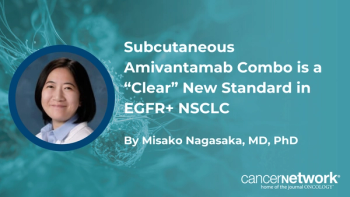
Subcutaneous amivantamab is safer and more convenient for patients compared with the intravenous formulation, according to Misako Nagasaka, MD, PhD.
David R. Gandara, MD, explains what makes KRAS G12C biologically distinct from other KRAS subtypes in NSCLC immunotherapy response.
In a retrospective genomic analysis from the
David R. Gandara, MD, director of thoracic oncology and co-director of the Center for Experimental Therapeutics in Cancer at UC Davis Comprehensive Cancer Center, who presented these findings at the meeting, spoke with CancerNetwork® about what makes KRAS G12C biologically distinct from other KRAS subtypes.
Transcript:
CancerNetwork: Given an OS hazard ratio of 0.18 and a median that was not reached in the KRAS G12C-mutated subgroup, what do you think is biologically distinct about G12C, specifically, vs other KRAS subtypes that could explain such an outsized effect?
Gandara: What most oncologists may not realize is that there are many KRAS mutations in cancer, and they’re quite diverse. For some of them, the patients’ cancers are relatively insensitive to immunotherapy; an example would be KRAS G12D. The polar opposite of that mutation is KRAS G12C. It’s a highly neoantigenic mutation. What that means is that it stimulates the immune system, and the reason for that is probably tied to the fact that almost every patient with this mutation was a former or current smoker, so it’s highly associated with tobacco carcinogenesis. It’s also the kind of transversion mutation that is stimulatory to the immune system.
We knew that background going in, and since we had a large phase 3 trial, we wanted to see how that played out in a trial where half the patients received cemiplimab immunotherapy by itself, as a single agent, vs platinum chemotherapy.
Gandara DR, Anagnostou V, Forde P, et al. KRAS G12C predicts superior outcomes with 1st line cemiplimab for non-squamous aNSCLC with PD-L1 ≥50%: data from EMPOWER-Lung 1. Presented at: 2026 World Conference on Lung Cancer; September 12-15, 2026; Seoul, South Korea. Abstract MO05.07.