Panelists discuss the challenges of managing intermediate-risk metastatic clear cell renal cell carcinoma (ccRCC) after progression on first-line immunotherapy (IO)/tyrosine kinase inhibitor (TKI) therapy, emphasizing cabozantinib’s role, individualized dosing strategies, proactive toxicity management, and the importance of patient-centered care to optimize long-term disease control and quality of life.
Panelists discuss evolving second-line treatment strategies for clear cell renal cell carcinoma (ccRCC), emphasizing the impact of first-line regimens, the growing role of tyrosine kinase inhibitors (TKIs) and emerging combinations, and the need for clinical judgment in sequencing therapies to balance disease control, symptom management, and patient quality of life.
Panelists discuss the shift toward a more personalized approach in metastatic renal cell carcinoma (RCC) management, highlighting the evolving role of risk stratification, the renewed interest in immune checkpoint inhibitors for favorable-risk patients, and the strategic integration of systemic therapy, active surveillance, and surgical interventions to optimize long-term outcomes.
Panelists discuss current strategies for first-line treatment sequencing in renal cell carcinoma (RCC), emphasizing immunotherapy-based combinations tailored to disease burden and patient characteristics, while highlighting the importance of multidisciplinary care, real-world experience, and clinical trial data in guiding personalized, patient-centered decisions.
Medical experts describe the decision-making process between choosing an IO-IO vs an IO-TKI regimen for first-line treatment, considering factors such as safety profile and response in both community and academic settings.
Medical experts will discuss the updated NCCN guidelines favoring ipilimumab + plus nivolumab for patients with favorable risk, including the data supporting this change and its the potential impact on the disease landscape.
Medical experts discuss significant adverse effects of TKIs and IOs, including management and patient education, and highlight exciting pipeline therapies for non–clear cell RCC, such as Ipi + Nivo and zanzalintinib + Nivo.
Medical experts explore how non–clear cell RCC histology impacts treatment selection, addressing challenges with less common subtypes vs more frequent ones, and discuss how clinical data and experience inform treatment sequencing and shared decision-making.
Medical experts discuss clinical trials supporting alternative therapies for advanced non–clear cell RCC, including Cabo alone, Nivo + Cabo, and others, and whether these studies covered all histologies.
Medical experts review long-term data from the KEYNOTE-B61 trial on pembrolizumab and lenvatinib, compare its efficacy and safety across non–clear cell RCC subtypes, and discuss dose management and safety relative to the CLEAR trial.
Medical experts outline the current first-line treatment options for advanced non–clear cell RCC, including the factors influencing agent selection, as well as discuss how recent NCCN guideline updates and label changes affect treatment decisions in community practice.
Medical experts explore the main challenges in treating non–clear cell RCC compared with clear cell RCC, discussing how these difficulties vary between community and academic settings.
Medical experts give an overview of renal cell carcinoma (RCC), detailing the differences between clear cell and non–clear cell subtypes, the various forms of non–clear cell RCC, and the demographic and risk factor profiles associated with each subtype, while also discussing how histological differences influence prognosis.
Medical experts compare the updated results of a Phase II trial and KEYNOTE B-61, both presented at ASCO 2024, giving a comprehensive overview of these pivotal studies.
The expert panel explores predictors of chromophobe renal cell carcinoma recurrence and other critical factors that inform treatment decisions for patients.
Renal cell carcinoma specialists provide a comprehensive overview of chromophobe renal cell carcinoma (ChRCC), including its definition, background, and distinctive characteristics.
Key opinion leaders analyze the latest advancements and research findings specific to Non-Clear Cell Renal Cell Carcinoma presented at the American Society of Clinical Oncology 2024 conference.
Key opinion leaders examine the application of tyrosine kinase inhibitors (TKIs) and evaluate first-line therapeutic approaches for renal cell carcinoma.
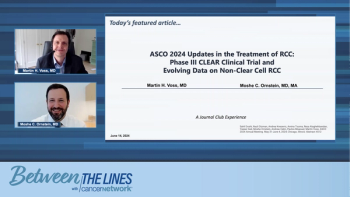
Key opinion leaders analyze recent findings from the CLEAR trial presented at ASCO 2024, focusing on the four-year follow-up data for progression-free survival and overall survival outcomes.
Clinicians are learning how to identify adverse effects relating to either immunotherapy or tyrosine kinase inhibitors for patients with advanced renal cell carcinoma.
Closing out their program on renal cell carcinoma management, key opinion leaders share closing thoughts on emerging therapies and how the field is evolving.
Centering discussion on sarcomatoid and rhabdoid non-clear cell renal cell carcinoma, panelists consider frontline IO-based regimens and their value in this setting.