Moshe C. Ornstein, MD, MA, of Cleveland Clinic explains to Elizabeth R. Plimack, MD, MS, of Fox Chase Cancer Center why bone metastases do not drive his first-line regimen choice in advanced renal cell carcinoma (RCC).
Moshe C. Ornstein, MD, MA, of Cleveland Clinic explains to Elizabeth R. Plimack, MD, MS, of Fox Chase Cancer Center why bone metastases do not drive his first-line regimen choice in advanced renal cell carcinoma (RCC).
Terence W. Friedlander, MD, of UCSF Helen Diller Family Comprehensive Cancer Center tells Elizabeth R. Plimack, MD, MS, of Fox Chase Cancer Center that simply counting metastatic sites is not a helpful way to assign first-line therapy in advanced renal cell carcinoma (RCC), unless a single site can be removed or irradiated.
Moshe C. Ornstein, MD, MA, of Cleveland Clinic and Terence W. Friedlander, MD, of UCSF Helen Diller Family Comprehensive Cancer Center describe the data that would sharpen first-line decisions in advanced renal cell carcinoma (RCC), in a discussion moderated by Elizabeth R. Plimack, MD, MS, of Fox Chase Cancer Center.
Terence W. Friedlander, MD, of UCSF Helen Diller Family Comprehensive Cancer Center explains why he does not save effective drugs for later in advanced renal cell carcinoma (RCC), responding to Elizabeth R. Plimack, MD, MS, of Fox Chase Cancer Center.
Moshe C. Ornstein, MD, MA, of Cleveland Clinic says clinicians cannot yet predict which patient with advanced renal cell carcinoma (RCC) will respond better to dual immune checkpoint blockade or to immunotherapy plus a tyrosine kinase inhibitor (TKI), in a discussion moderated by Elizabeth R. Plimack, MD, MS, of Fox Chase Cancer Center.
Elizabeth R. Plimack, MD, MS, of Fox Chase Cancer Center opens this CancerNetwork Training Academy discussion on first-line treatment decisions in advanced renal cell carcinoma (RCC) with Terence W. Friedlander, MD, of UCSF Helen Diller Family Comprehensive Cancer Center, and Moshe C. Ornstein, MD, MA, of Cleveland Clinic.
In this closing segment on advanced renal cell carcinoma, Dr. Ornstein synthesizes key themes from the case discussion, emphasizing how disease biology and clinical presentation guide second-line treatment decisions. He highlights that patients with early progression after frontline therapy represent a higher-risk group that often requires a more aggressive treatment approach.
In this case-based segment on advanced renal cell carcinoma, Dr. Ornstein introduces a patient with high disease burden who progresses within 8 months of frontline immunotherapy plus VEGF receptor targeted therapy, highlighting a more aggressive disease course. He emphasizes that early progression and limited depth of response raise concern for more refractory disease biology.
In this forward-looking segment on advanced renal cell carcinoma, Dr. Ornstein asks the panel to consider how treatment decisions may evolve if newer combination therapies become available in the second-line setting. He introduces the potential role of lenvatinib combined with belzutifan and asks how this regimen might fit into clinical practice.
In this segment on advanced renal cell carcinoma, Dr. Ornstein asks how clinicians differentiate among VEGF receptor targeted therapies when selecting treatment for patients with slower disease progression after prior immunotherapy. He highlights the perception that different TKIs may vary in both efficacy and toxicity.
In this case-based segment on advanced renal cell carcinoma, Dr. Ornstein presents a patient with intermediate-risk disease who experienced progression after 14 months of frontline dual immune checkpoint inhibitor therapy. He highlights the importance of interpreting prior treatment response and clinical status when selecting second-line therapy.
In this case-based segment on advanced renal cell carcinoma, Dr. Ornstein presents a patient who progresses after frontline immunotherapy plus VEGF receptor targeted therapy, with prior tolerability challenges including hand-foot syndrome and diarrhea. He highlights the expanding range of second-line options, including HIF-2α inhibitors.
In this case-based segment on advanced renal cell carcinoma, Dr. Ornstein presents a clinical scenario of a patient with disease progression after frontline dual immune checkpoint inhibitor therapy, emphasizing the need to individualize second-line treatment decisions in the absence of certain emerging approvals.
In this segment on advanced renal cell carcinoma, Dr. Ornstein explores real-world transition rates from first-line to subsequent lines of therapy, asking how often patients reach second- and third-line treatment in clinical practice.
In this segment on advanced renal cell carcinoma, Dr. Ornstein transitions the discussion to the second-line setting, noting that most patients will eventually experience disease progression and require additional therapy. He highlights that treatment goals evolve in the refractory setting, where achieving disease control becomes the primary objective rather than long-term durable remission.
In this segment on advanced renal cell carcinoma, Dr. Ornstein emphasizes that treatment is only effective if patients are able to remain on therapy, framing dose management as a critical component of clinical care. He asks how clinicians approach dosing and tolerability, particularly with VEGF receptor targeted therapy–based combinations.
In this segment on advanced renal cell carcinoma, Dr. Ornstein raises the important issue of real-world treatment attrition, noting that not all patients are able to receive subsequent lines of therapy after disease progression. He frames this as a key consideration when selecting first-line treatment.
In this segment on advanced renal cell carcinoma, Dr. Ornstein shifts the discussion to the role of treatment sequencing when selecting first-line therapy. He raises the question of how anticipated second-line options may influence initial treatment decisions in the context of multiple effective frontline regimens.
In this segment on advanced renal cell carcinoma, Dr. Ornstein guides the discussion toward differentiating available frontline treatment options, focusing on the choice between dual immune checkpoint inhibitor therapy and combinations of immunotherapy with VEGF receptor targeted therapies.
In this opening segment on advanced renal cell carcinoma, Ornstein introduces the evolving frontline treatment landscape, highlighting the expanded role of immune checkpoint inhibitor–based combinations and VEGF receptor–targeted therapies.
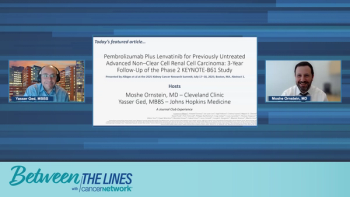
Panelists discuss how pembrolizumab plus lenvatinib has established a new benchmark and become the preferred first-line treatment option for more than 95% of patients with non–clear cell renal cell carcinoma (RCC), according to national guidelines, demonstrating activity across all major histological subtypes despite the heterogeneous nature of these diseases, while acknowledging that specific rare histologies may still require tailored approaches.
Panelists discuss how managing the safety profile of pembrolizumab plus lenvatinib requires proactive patient education and early toxicity identification, with approximately 25% of patients discontinuing therapy due to adverse events in both clinical trials and real-world practice, emphasizing the importance of distinguishing between tyrosine kinase inhibitor (TKI) and immunotherapy-related adverse events for appropriate management.
Panelists discuss how the KEYNOTE-B61 study demonstrated impressive survival outcomes with a median progression-free survival (PFS) of 17.9 months and median overall survival (OS) of 41.5 months, effectively doubling the historical tyrosine kinase inhibitor (TKI) monotherapy benchmarks of 8 to 9 months PFS and 21 months OS in patients with non–clear cell renal cell carcinoma (RCC).
Panelists discuss the ongoing challenges and progress in treating non–clear cell renal cell carcinoma (nccRCC), emphasizing the need for subtype-specific trials, mechanistically driven therapy, and international collaboration to move beyond data extrapolation from clear cell RCC (ccRCC) and toward truly evidence-based, personalized care.
Panelists discuss the future of clear cell renal cell carcinoma (ccRCC) treatment, focusing on optimizing sequencing and combinations of existing therapies, integrating novel agents like belzutifan and cellular therapies, and advancing research through clinical trials and investigator-led studies to drive more personalized and effective care.
Panelists discuss how the durability of response data was particularly compelling, with a median duration of response of approximately 2 years and 35% of patients maintaining responses at 3 years, especially noting the surprising 31% response rate in chromophobe renal cell carcinoma (RCC) despite this histology's historically poor responsiveness to immunotherapy due to low tumor mutational burden.
Panelists discuss how the KEYNOTE-B61 study demonstrated remarkable efficacy with a 50.6% objective response rate and 82% disease control rate across all non–clear cell renal cell carcinoma (RCC) histologies, representing a significant improvement over historical tyrosine kinase inhibitor (TKI) data that showed response rates below 30% and setting a new treatment benchmark for this patient population.
Panelists discuss the ongoing challenge of lacking reliable biomarkers in renal cell carcinoma (RCC), emphasizing promising advances in RNA expression signatures and emerging tools like protein biomarkers and circulating tumor DNA (ctDNA) to personalize treatment and improve real-time therapy decisions despite current limitations.
Panelists discuss the nuanced approach to adverse effect management in non–clear cell renal cell carcinoma (nccRCC), highlighting a shift from aggressive toxicity management in the first-line setting aimed at prolonging survival to a patient-centered focus on quality of life and tolerability in later lines, emphasizing open communication and long-term treatment endurance.
Panelists discuss how the KEYNOTE-B61 study population truly represents real-world clinical practice, with papillary renal cell carcinoma (RCC) being the most common subtype followed by chromophobe, unclassified, and translocation RCC as the top 4 subtypes typically encountered in clinic, while rarer variants comprise only 2% to 3% of non–clear cell cases.
Published: September 13th 2024 | Updated: November 25th 2024
August 9th 2023
September 5th 2023
July 28th 2023