Adding bortezomib to Isa-Rd triplet therapy enhanced MRD-negative responses in patients with transplant-ineligible multiple myeloma.
Adding bortezomib to Isa-Rd triplet therapy enhanced MRD-negative responses in patients with transplant-ineligible multiple myeloma.
Isatuximab plus VRd triplet therapy did not significantly increase toxicity in patients with transplant-ineligible multiple myeloma in the IMROZ trial.
Isatuximab quadruplet therapy for patients with multiple myeloma prolonged progression-free survival when compared with VRd triplet therapy.
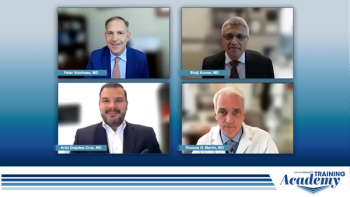
Focusing on treatment paradigms for patients with relapsed/refractory multiple myeloma, the expert panel discusses the role of BCMA-targeted bispecifics and how they might consider sequencing therapies.
Following the presentation of a case of a patient with multiple myeloma, the panel have a roundtable discussion on how to approach treatment.
A panel of myeloma specialists review the case of a 67-year-old patient with multiple myeloma (MM) who received a bispecific antibody.
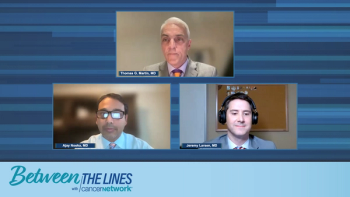
Thomas Martin, MD; Ajay Nooka, MD; and Jeremy Larsen, MD, share closing thoughts on the evolving landscape of cytokine release syndrome management in relapsed/refractory multiple myeloma.
Following their review of data from MajesTEC-1, panelists consider how they manage patients with cytokine release syndrome in the real-world setting.
Key opinion leaders Thomas Martin, MD; Ajay Nooka, MD; and Jeremy Larsen, MD, reflect on the use of tocilizumab in patients experiencing cytokine release syndrome on MajesTEC-1.
Focused discussion on the advent of cytokine release syndrome in MajesTEC-1 and how it compared to the benefits derived from teclistamab therapy.
Experts on multiple myeloma discuss how to select treatment options in later lines of therapy.
Key opinion leaders share comprehensive insight to the treatment armamentarium for patients with relapsed/refractory multiple myeloma.
Experts Thomas Martin, MD; Ajay Nooka, MD; and Jeremy Larsen, MD, provide a broad overview of cytokine release syndrome as it relates to the management of multiple myeloma.
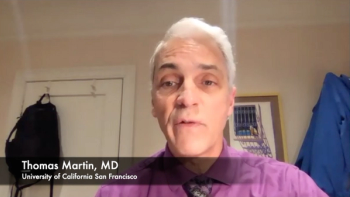
Thomas Martin, MD, spoke about how the approval of ciltacabtagene autoleucel for patients with relapsed/refractory multiple myeloma may change the standard of care in this setting.
Thomas Martin, MD, spoke about how to increase response durability with ciltacabtagene autoleucel for patients with heavily pretreated multiple myeloma.
Thomas Martin, MD, spoke about which patient population with relapsed/refractory multiple myeloma would benefit most from treatment with ciltacabtagene autoleucel.
Thomas Martin, MD, spoke about the importance of the approval of ciltacabtagene autoleucel to treat patients with pretreated multiple myeloma.
Thomas G. Martin, MD, spoke about the updated results of the CARTITUDE-1 study examining ciltacabtagene autoleucel in relapsed or refractory multiple myeloma.
Thomas G. Martin, MD, spoke about the previously reported results of the CARTITUDE-1 study in patients with relapsed or refractory myeloma ahead of the 2021 ASH Annual Meeting.
Thomas G. Martin, MD, spoke about the abstracts regarding B-cell maturation antigen–targeted treatments he’s excited to see presented at ASH 2021.
Thomas G. Martin, MD, spoke about different abstracts to be presented at ASH 2021.

The adverse event profile of single-agent carfilzomib suggests that the agent is an important treatment option for patients with advanced multiple myeloma, particularly those with pre-existing peripheral neuropathy or those who are at risk for the development of peripheral neuropathy.