Tyler J. Wilhite, MD, discussed scaling low-dose radiation therapy for osteoarthritis from 1 patient to nearly 20 centers and the referral work behind it.
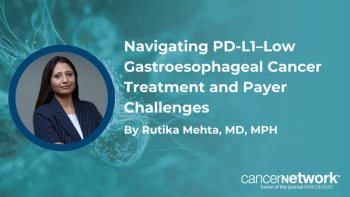
Rutika Mehta, MD, MPH, discussed biomarker testing, PD-L1–low treatment, FLOT dosing, early referral, and ctDNA in gastroesophageal cancer.
CancerNetwork® spoke with Rutika Mehta, MD, MPH, director of Upper Gastrointestinal (GI) Medical Oncology at NYU Langone Health’s Perlmutter Cancer Center, about practical considerations in the management of gastroesophageal cancer. Mehta discussed how she sequences biomarker testing to conserve tissue, her approach to patients with PD-L1–low or –negative disease, including use of perioperative durvalumab (Imfinzi) plus FLOT (fluorouracil, leucovorin, oxaliplatin, and docetaxel) based on the phase 3 MATTERHORN trial (NCT04592913)1 and first-line options such as zanidatamab-hrii (Ziihera) with or without tislelizumab-jsgr (Tevimbra) from the phase 3 HERIZON-GEA-01 trial (NCT05152147)2 and claudin 18.2–directed zolbetuximab-clzb (Vyloy).3,4 She also shared her framework for FLOT dose modifications, strategies to ensure upfront medical oncology referral, and the role of ctDNA in future trials.
That’s a very critical question. One of the major criticisms we always face as academicians from community physicians is that, yes, it’s great to have different biomarker testing done and available to guide treatment decisions and to help patients be offered clinical trials. The truth of the matter is, be it community practice or academic settings, tissue becomes an issue. The amount of tissue that has been collected from either the initial endoscopy or from a metastatic site is typically quite limited.
I try to prioritize. I typically find out whether a tumor is mismatch repair deficient or microsatellite instability–high [MSI-H] through a liquid biopsy, so MSI is the last test I would use tissue for. I typically get MSI testing through liquid biopsy, and then I try to prioritize HER2, claudin 18.2, and then PD-L1, in that order. That way, I can save some tissue. If there is no scarcity of tissue, then we can typically do all 4 of those on immunohistochemistry.
In the locally advanced setting, when I am deciding what to give my patients, especially if they have a tumor area positivity (TAP) score of less than 1%, I still would offer them D-FLOT, which is FLOT plus durvalumab. Again, go back to the original study, where less than 10% of patients had a TAP score of less than 1%. It’s a small subpopulation of patients, and therefore any data that we have been able to see from the MATTERHORN study cannot be broadly applied, since it’s a curative-intent setting and the hazard ratio did not significantly cross over 1.1 I tend to prefer D-FLOT even in the TAP-negative patients. Based on the FDA approval, that’s reasonable. If there is a payer that’s giving me a hard time with approval of durvalumab in combination with FLOT, then I try to get an appeal and reiterate the FDA approval.
In the metastatic setting, it can be quite tricky. Now we have new treatment paradigms. In the HER2-positive setting, it doesn’t matter what your PD-L1 status is. There is now approval of chemotherapy plus zanidatamab with or without tislelizumab, so in the HER2-positive setting, it’s less of a concern.2 In the claudin-positive patients, if they’re extremely positive, then I prefer a claudin-directed treatment. The patients who remain are the HER2-negative and claudin-negative patients. My threshold has been a combined positive score (CPS) of 5 for giving them immunotherapy. If I feel like there is a low burden of disease and the patient would probably do well over an extended period of time, I will prioritize giving them a checkpoint inhibitor as long as their CPS is 1 or more.
FLOT dosing has been a constant challenge for my elderly, frail patients. If they’re still surgical candidates, I prefer doing a doublet like FOLFOX, although it’s not ideal. In my otherwise young patients who are candidates for surgery, I start with FLOT, and I preemptively give them growth factor support with the first treatment because I know that their counts will drop. Then I learn how their counts recover with the second cycle, and that helps me decide if I need to give it every time or every other time.
When toxicities start, typically neuropathy, I try to do a global dose reduction of both oxaliplatin and docetaxel together. I try not to drop one agent completely, because I still want to give them some benefit of a triplet regimen. If they’re having [adverse] effects that are more significant with one or the other, like docetaxel causing significant edema that I’m not able to resolve with steroids, then of course I’ll have to drop that. Or if they had an infusion reaction to oxaliplatin, then I would drop oxaliplatin altogether. If I do that, I also tend to increase the 5-fluorouracil continuous pump from 24 hours to 46 hours when I’m giving just 2 agents, as we do with FOLFOX.
Education all around, not just for medical oncologists but also for surgeons and gastroenterologists, is key. The more gastroenterologists and surgeons are aware of the data, especially around MATTERHORN, the more there will be a push to refer these patients early on to medical oncologists.1 From a payer standpoint as well, payers should have a system of ensuring that these patients have had medical oncology referrals before a surgery has been scheduled.
This is something we touched upon earlier. Claudin 18.2–targeted treatment with zolbetuximab is already in use.3,4 If I feel like there isn’t enough tissue, and I always like to discuss this with my pathologist, then I try to prioritize HER2, claudin, and PD-L1, in that order, and then use a liquid biopsy to get me the MSI results. If tissue is not an issue, then it’s great to have all 4 of those together. I also like to reserve some of that tissue for next-generation sequencing, because that’s become pretty key with how the field is expanding, with multiple new targets being discovered.
I don’t have a crisp answer for what the NCI task force’s vision is, but there have been several conversations among task force members about what trials would best fit the needs of both community and academic centers in order to advance the field for upper GI cancers and benefit patients. There are several concepts in development right now that focus on de-escalating treatment, switching treatments, and trying different modalities of treatment, both for locally advanced and for metastatic cancers. Use of ctDNA as a surrogate marker to help guide that de-escalation or escalation is also being looked into.
The one caveat to using ctDNA to guide how we design our treatments is that we need more uptake of ctDNA in commercial use in routine practice, so that most physicians have the confidence to say, yes, ctDNA can be detected in upper GI malignancies, there is definitely a trend in the dynamics that can be tracked over time, and it has helped them understand whether the patient is going to recur early or not recur at all. I think just having more clinical experience with ctDNA will be very critical before such trials come into play.
1. Janjigian YY, Al-Batran SE, Wainberg ZA, et al. Perioperative durvalumab in gastric and gastroesophageal junction cancer. N Engl J Med. 2025;393(3):217-230. doi:10.1056/NEJMoa2503701
2. Elimova E, Rha SY, Shitara K, et al. Zanidatamab + chemotherapy (CT) ± tislelizumab for first-line (1L) HER2-positive (HER2+) locally advanced, unresectable, or metastatic gastroesophageal adenocarcinoma (mGEA): primary analysis from HERIZON-GEA-01. J Clin Oncol. 2026;44(suppl 2):LBA285. doi:10.1200/JCO.2026.44.2_suppl.LBA285
3. Shitara K, Lordick F, Bang YJ, et al. Zolbetuximab plus mFOLFOX6 in patients with CLDN18.2-positive, HER2-negative, untreated, locally advanced unresectable or metastatic gastric or gastro-oesophageal junction adenocarcinoma (SPOTLIGHT): a multicentre, randomised, double-blind, phase 3 trial. Lancet. 2023;401(10389):1655-1668. doi:10.1016/S0140-6736(23)00620-7
4. Shah MA, Shitara K, Ajani JA, et al. Zolbetuximab plus CAPOX in CLDN18.2-positive gastric or gastroesophageal junction adenocarcinoma: the randomized, phase 3 GLOW trial. Nat Med. 2023;29(8):2133-2141. doi:10.1038/s41591-023-02465-7