



























































The addition of abemaciclib to fulvestrant significantly improved PFS and time to subsequent chemotherapy in pre- and perimenopausal HR-positive/HER2-negative breast cancer patients.
The addition of abemaciclib to fulvestrant significantly improved PFS and time to subsequent chemotherapy in pre- and perimenopausal HR-positive/HER2-negative breast cancer patients.
The combination of ribociclib and fulvestrant yielded an improvement in progression-free survival in postmenopausal women with advanced breast cancer, according to the MONALEESA-3 trial.
Several different driver mutations acquired during treatment for breast cancer can help explain acquired resistance to the combination of palbociclib and fulvestrant.
Tumor gene expression testing identifies women with certain early-stage breast cancers who can safely skip chemotherapy.
The PI3K inhibitor taselisib offered less dramatic clinical benefits than anticipated, and with significant toxicities.
Ribociclib plus endocrine therapy resulted in improved PFS in premenopausal women with HR+, HER2− advanced breast cancer.
Researchers have developed a “disease screening pill” that could allow for a noninvasive and safe method for detecting breast cancer using only near-infrared light.

Women with HER2-positive early breast cancer achieved similar disease-free survival with 6 months of adjuvant trastuzumab compared with a 12-month duration, according to the phase III PERSEPHONE trial.
A Moffitt team suggests mathematical modeling may guide the optimal cancer treatment dosing approach better than MTD.
TPIV200 stimulates T cells to attack ovarian and triple-negative breast tumor cells that over-express the folate receptor alpha protein.
Here, we discuss how to improve adherence to endocrine therapy in women with HR-positive breast cancer, as well as the side effects and the reasons for discontinuation.
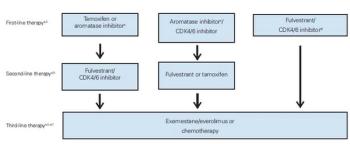
Here, we review the current use of and potential next directions for CDK4/6 inhibitors in the treatment of patients with HR-positive breast cancer.
New research has found that expression of AXL is correlated with poor outcomes in patients with HER2-positive breast cancer.
A laboratory study has found that the HER2 inhibitor lapatinib used to slow HER2-positive breast cancer can actually induce tumor growth in some circumstances.
Researchers have developed a new model to help predict the development of breast cancer in women with atypical hyperplasia based on a breast biopsy.

In this video, Dr. Melissa Davis explains how African ancestry may play a role in breast cancer, and ways that genetics might be used to help guide treatment.

In this video, Dr. Elizabeth Swisher reviews the use of PARP inhibitors in breast cancer, and the importance of understanding how resistance to these agents develops.
A simple prognostic tool could be used to identify patients with HR-positive breast cancer who underwent 5 years of endocrine treatment and who might be at higher risk of late distant recurrence.

In this video, Dr. Arman Rahman explains how the OncoMasTR protein assay may help women with breast cancer avoid unnecessary chemotherapy.
A biomarker known as RAD51 was found to be correlated with resistance to PARP inhibitor treatment in a study of breast cancer that harbors BRCA mutations.

Reversible ovarian function suppression using LHRH agonists is the preferred first treatment for most premenopausal breast cancer patients.

Though LHRH agonists may be the preferred method of ovarian function suppression, ovarian ablation is a viable option for select premenopausal breast cancer patients.
Laboratory studies suggest that mechanisms of resistance to tyrosine kinase inhibitor therapy differ between the specific subtypes of HER2-positive breast cancer.

Two new studies have found that some HER2-positive and triple-negative breast cancer patients can avoid sentinel lymph node biopsy after neoadjuvant systemic therapy.
The rate of severe acute toxicity was relatively low in a study of radiosensitization with veliparib for patients with inflammatory or locally recurrent breast cancer.